Numeric control
With this flag all of the numerical methods and input parameters can be
controlled when
- solving strain
- solving the Poisson equation
- solving the nonlinear Poisson equation
- solving the current equation
- solving the coupled Poisson-current equation
- solving the Schrödinger equation (1-band, 6-band k.p, 8-band k.p)
- solving the coupled Schrödinger-Poisson equation
- solving the coupled Schroedinger-Poisson-current equation
- ...
Other options:
- Schrödinger-Poisson predictor-corrector method
- scale Poisson equation
- scale current equation
- factor for separation energy
- evaluation of Fermi functions
- starting value for the electrostatic potential - initial guess
- k.p options
- ...
!---------------------------------------------------------------!

$numeric-control
  optional !

 simulation-dimension
integer
required !


!

 strain-lin-eq-solv


character      optional !

 strain-symm-sparse-matrix
character      optional !

 strain-iterations
integer
  optional !

 strain-residual
   double
  optional !

 strain-volume-correction-residual
double
    optional !

 strain-volume-correction-iterations
integer
  optional !

 filling-factor-for-ILU-decomposition
integer        optional
!


!

 discretize-only-once
character      optional !


!

 newton-method
character
optional
! 1D/2D/3D

 newton-max-linesearch-steps
character      optional
! 1D/2D/3D


!

 nonlinear-poisson-iterations

 integer        optional !
1D/2D/3D

 nonlinear-poisson-residual

 double         optional !
1D/2D/3D

 nonlinear-poisson-stepmax

 double         optional !
1D/2D/3D

 nonlinear-poisson-cg-lin-eq-solv

 character      optional !
1D/2D/3D

 nonlinear-poisson-cg-iterations

 integer        optional !
1D/2D/3D

 nonlinear-poisson-cg-residual

 double         optional !
1D/2D/3D


!

 current-poisson-method


character      optional ! 1D/2D/3D

 current-poisson-lin-eq-solv


character      optional ! 1D/2D/3D

 current-poisson-lin-eq-solv-iterations integer        optional !
1D/2D/3D

 current-poisson-lin-eq-solv-residual   double
     optional
! 1D/2D/3D

 current-poisson-iterations
integer        optional !
1D/2D/3D

 current-poisson-residual

  double         optional
! 1D/2D/3D


!

 current-block-iterations-Fermi
integer        optional
! 1D/2D/3D

 current-block-relaxation-Fermi
double         optional
! 1D/2D/3D


!

 coupled-current-poisson-iterations
 integer
optional !
1D/2D/3D

 coupled-current-poisson-residual
 double         optional !
1D/2D/3D

 coupled-current-poisson-stepmax
 double         optional !
1D/2D/3D


!

 current-problem
character      optional ! 1D/2D/3D

 current-problem-iterations
integer        optional ! 1D/2D/3D

 current-problem-cg-iterations
integer        optional ! 1D/2D/3D

 current-problem-cg-residual
double
optional ! 1D/2D/3D


!

 schroedinger-1band-ev-solv

character      optional !

 schroedinger-1band-iterations

 integer        optional !

 schroedinger-1band-residual

 double         optional
!

 schroedinger-1band-more-ev
   integer
optional
!


!

 schroedinger-chearn-el-cutoff

 double
optional
!

 schroedinger-chearn-hl-cutoff

 double
optional
!


!

 schroedinger-kp-ev-solv

character      optional !

 schroedinger-kp-iterations
   integer
optional
!

 schroedinger-kp-residual
   double
optional
!

 schroedinger-kp-more-ev
   integer        optional
!

 schroedinger-kp-discretization

character      optional !

 schroedinger-kp-basis

character      optional !


!

 schroedinger-poisson-problem
       character      optional !
1D/2D/3D

 schroedinger-poisson-precor-iterations integer
     optional !
1D/2D/3D

 schroedinger-poisson-precor-residual
double
 optional !
1D/2D/3D


!

 poisson-boundary-condition-along-x
character
optional
! 1D/2D/3D

 poisson-boundary-condition-along-y
character      optional
! 1D/2D/3D

 poisson-boundary-condition-along-z
character
optional
! 1D/2D/3D


 scale-poisson
double
  optional !
1D/2D/3D

 scale-current
double         optional !
1D/2D/3D


!

 fermi-function-mode
character      optional !
1D/2D/3D

 fermi-function-precision
double         optional !
1D/2D/3D

 carrier-statistics
character      optional !
1D/2D/3D


!

 potential-from-function
character      optional !
new
 initial-potential
double         optional
!

 zero-potential
character      optional !

 built-in-potential-qm
character      optional !


!

 separation-energy-shift
double
optional ! 1D/2D/3D

 separation-energy-shift-eV
double
optional ! 1D/2D/3D


!

 schroedinger-masses-anisotropic
character
  optional ! 1D/2D/3D


!

 use-band-gaps
character      optional !

 varshni-parameters-on
character      optional !

 lattice-constants-temp-coeff-on
character      optional !


!

 Luttinger-parameters
character      optional !

 Kane-momentum-matrix-element
character
    optional !


!

 valence-band-masses-from-kp
character      optional ! 1D/2D/3D


!

 kp-cv-term-symmetrization
character
 optional !

 kp-vv-term-symmetrization
character      optional !


!

 8x8kp-params-from-6x6kp-params
character
 optional !

 8x8kp-params-rescale-S-to

character      optional !


!

 quantization-axis-of-spin

character      optional !


!

 valence-bandedge-energies-zb
character      optional !

 valence-bandedge-energies-wz
character      optional !


!

 strain-transforms-k-vectors

character
  optional ! 1D/2D/3D


!

 broken-gap
character      optional !


!

 piezo-charge-at-boundaries


character
optional ! 1D/2D/3D

 pyro-charge-at-boundaries


character      optional ! 1D/2D/3D


!

 piezo-second-order

character      optional !

 piezo-constants-zero


character      optional !

 pyro-constants-zero


character
  optional !


!

 discontinous-charge-density-1band

character
  optional ! 1D/2D


!

 superlattice-option


character
   optional !

 superlattice-save-wavefunctions


character
   optional !


!

 exchange-correlation


character
   optional !


!

 coulomb-matrix-element
character      optional ! 1D/2D/3D

 calculate-exciton
character      optional ! 1D/2D/3D

 exciton-lambda
double
optional ! 1D

 exciton-lambda-step-length
double
optional ! 1D

 exciton-iterations
integer
optional ! 1D/2D/3D

 exciton-residual
double
optional ! 1D/2D/3D

 exciton-electron-state-number
integer_array  optional ! 1D/2D/3D

 exciton-hole-state-number
integer_array  optional ! 1D/2D/3D

 number-of-electron-states-for-exciton  integer
optional ! 1D/2D/3D

 number-of-hole-states-for-exciton
integer
optional ! 1D/2D/3D


!

 tight-binding-method
character      optional !
1D/2D/3D


 tight-binding-parameters

double_array

  optional ! 1D/2D/3D

 tight-binding-calculate-parameter
character      optional !
1D/2D/3D


!

 graphene-potential-fluctuation
double_array
 optional !


!

 get-k-vector-dispersion-for-lead-modes
character      optional ! 1D/2D/3D


!

$end_numeric-control
optional !

!---------------------------------------------------------------!
Syntax
simulation-dimension = 1 !
for 1D simulation
= 2 !
= 3 !
Strain (strain-minimization, 2D/3D only)
Minimization of the elastic
energy (i.e. minimization of the integral over the elastic energy density)
strain-lin-eq-solv = BiCGSTAB !
                   =
PCG_Kent !
Switch between
- BiCGSTAB (BiConjugate Gradient Stabilized) algorithm and
- Preconditioned Conjugate Gradient (written by Kent Smith, Agere Systems), ILU
as preconditioner
for solving strain equation: solve linear system Ax=b for x.
1D: not implemented
2D: BiCGSTAB/PCG_Kent
3D: BiCGSTAB/PCG_Kent
filling-factor-for-ILU-decomposition = 10
!
(default)
This is an optimization parameter for the
PCG_Kent algorithm.
Number of filling levels [0,n]
ILU: Incomplete LU factorization of a sparse matrix A
It is used as a preconditioner for solving the system of linear equations A.x =
b, where the matrix A is sparse, and A.x=b is solved with BiCGSTAB or another
conjugate gradient method.
For large matrices a smaller value than 10
is recommended.
ILU(0) has the same number of
offdiagonal matrix elements than the original sparse matrix A.
strain-symm-sparse-matrix = yes !

strain-symm-sparse-matrix = no  !
(default)
Obviously, the required storage is twice as much but the matrix-vector products
are faster.
If periodic boundary conditions are used for the strain matrix, then in any case
a nonsymmetric matrix is assumed.
Also, for free-standing structures, the strain matrix is nonsymmetric.
strain-iterations = 2000 ! -->
number of iterations for BiCGSTAB when calculating strain
strain-residual    = 1d-12
! -->
residual for strain calculation (BiCGSTAB)
These refer to the following variables in
control_numeric:
  -> INTEGER:  StrainIterations2D

  -> REAL:     StrainResidual2D

  -> INTEGER:  StrainIterations3D

  -> REAL:    StrainResidual3D
Example:
Dot calculations calculations for strain (4nm_dot.in with finest grid).
Results:
Input file:
strain-iterations  =

  4000      4000
  4000      4000      4000      4000

  strain-residual    =
  1.00d-13  1.00d-12
  1.00d-10  1.00d-09  1.00d-08  1.00d-06
Output:
No. of iterations        1356      1221
  615       411       67
  3

  final residual
  2.23E-08  ?
  4.31E-05  4.18E-04  4.40E-03  0.31E-00

  maximum value f. displ.  3.79E-11  3.79E-11  3.77E-11  4.38E-11  6.16E-11
  1.76E-11
(units m)
minimum value f. displ. -8.73E-11 -8.73E-11 -8.75E-11 -8.06E-11 -6.16E-11 -1.55E-11
So what is interesting is the fact that the final residual is always less
than the one specified as the actual residual. But the BiCGSTAB routine leaves
without errors of convergence.
As a conclusion the residual should be (at least 1.00d-10) in the input
file.
Strain algorithm which also works for free-standing structures
 strain-volume-correction-residual   =
1d-6 !
residual criteria for the
volume correction iteration (only relevant for strain-calculation =
strain-minimization-new)
strain-volume-correction-iterations = 50
!
 strain-calculation =
strain-minimization-new
)
Discretization of equations
Discretize equation twice or use linked list.
The thing is that if one uses lists it takes a lot of memory. So now one can
choose between CPU time or RAM.
 discretize-only-once = yes ! (default)


= no
If 'yes', the matrix elements of
the discretized equations are saved into a linked list,
and after that the elements from the list are written into a (sparse) matrix.
So the equation has to be discretized only once.
But this requires more memory (RAM) and can be critical for large simulations.
That's why the user can say 'no' and
then the discretization will be done twice,
first to count the number of matrix elements to be stored and second to store
them.
Of course, this will require the double time necessary for discretization.
This is related to the strain routine and to the box discretization method of
the Schrödinger equations.
Newton's method
newton-method = Newton-1 ! 1D/2D/3D
newton-method = Newton-2 !
newton-method = Newton-3 ! 1D/2D/3D
(default)
There are three different Newton method's implemented. 'Newton-1', 'Newton-2',
and 'Newton-3'. 'Newton-3'
is based on the C++ version of nextnano³.
This will affect the following equations:
- Classical nonlinear Poisson equation (
nonlinear-poisson-...)
- Nonlinear Schrödinger-Poisson equation based on predictor-corrector
approach (
nonlinear-poisson-...)
schroedinger-poisson-problem = precor ! (predictor-corrector)
- Coupled Current-Poisson equation in 1D (for Poisson equation) (
nonlinear-poisson-...)
current-poisson-method =
couple-all-true

                       =
couple-all-false
- Coupled Current-Poisson equation in 1D/2D (for current equation) (
coupled-current-poisson-)
current-poisson-method =
couple-all-true

                       =
couple-all-false
Note: For 'Newton-2' and 'Newton-3'
there is an additional specifier available which determines the maximum number
of steps for the linesearch:
newton-max-linesearch-steps = 20 !
1D/2D/3D
Nonlinear Poisson equation (classical or quantum mechanical):
nonlinear-poisson-iterations = 100 !
1D
nonlinear-poisson-iterations = 50 !
nonlinear-poisson-iterations = 50 !
nonlinear-poisson-residual = 1.0d-8 !
nonlinear-poisson-residual = 1.0d-12 !
nonlinear-poisson-residual = 1.0d-8 !
nonlinear-poisson-stepmax        =
1.0d-2   !
1D
nonlinear-poisson-stepmax = 1.0d-2 !
nonlinear-poisson-stepmax = 1.0d-2 !
-> NonLinPoissonIterationsXD ... maximum number of
iterations
-> NonLinPoissonResidualXD ... upper limit for
residual of functional
-> NonLinPoissonStepMaxXD ...
maximum step length
NonLinPoissonStepMax1D/2D/3D is an input quantity
that limits the length of the steps so that you do not try to evaluate the
function in regions where it is undefined or subject to overflow (used in
subroutine linesearch in subroutine
newton).
dtolmin                = 1.0d-2 -->
tolmin = tolf*dtolmin
! These values should not be altered.
NonLinPoissonStepMaxXD =
1.0d-2 --> in Newton
! These values should not be altered.
alf                    =
1.0d-4 -->
in
Newton
! These values should not be altered.
not implemented yet (maybe later):
NonLinPoissonIterations_actXD ... Values that are
actually used,
NonLinPoissonResidual_actXD ... can be varied in self-consistent calculation.
stage, delta, Arnoldi
epsilon_ev_rel_to_precision
Conjugate gradient method for nonlinear Poisson equation
Used for calculating one Newton correction step.
nonlinear-poisson-cg-lin-eq-solv = LAPACK !
1D (default
for 1D)
                                 =
LAPACK-full        !
                                 =
LAPACK-tridiagonal !
                                 =
cg                 !
                                 =
cg-MICCG           !
                                 =
cg-Jacobi          !
                                 =
PCG_Kent           !
- LAPACK
LAPACK routine
(banded matrix)
- LAPACK-full LAPACK routine
(full matrix)
- LAPACK-tridiagonal LAPACK routine
(tridiagonal matrix) (not implemented yet)
- cg
(conjugate gradient with default preconditioning (Jacobi))
- cg-MICCG
(conjugate gradient with modified incomplete Choleski preconditioning)
- cg-Jacobi
(conjugate gradient with Jacobi preconditioning)
- PCG_Kent
(Preconditioned conjugate gradient written by Kent Smith, faster than
cg)
nonlinear-poisson-cg-iterations =  1000
!
1D
nonlinear-poisson-cg-iterations =  1000
!
nonlinear-poisson-cg-iterations = 1000
!
nonlinear-poisson-cg-residual = 1.0d-6 !
1.0d-15
(classical ?)
nonlinear-poisson-cg-residual = 1.0d-6 !
nonlinear-poisson-cg-residual = 1.0d-6 !
NonLinPoissonCGLinEqSolvXD ...
linear equation solver for nonlinear Poisson equation
NonLinPoissonCGIterationsXD ... upper
limit for number of iterations for conjugate gradient
NonLinPoissonCGResidualXD ... value of residual
not implemented yet:
NonLinPoissonCGIterationsXD_act ...
NonLinPoissonCGResidualXD_axt ... Can be varied in self-consistent
solution.
More information can be found here:
nonlinear Poisson equation.
Current-Poisson equation
current-poisson-method = block-iterative !
Block-iterative
                       =
couple-all-true        !
!
(i.e. electrostatic potential, Fermi level electrons, Fermi level holes
are coupled)
                       =
couple-all-false       !
!
(i.e. electrostatic potential, Fermi level electrons, Fermi level holes
are not coupled)
                       =
couple-all-true-aniso  !
!
                       =
couple-all-false-aniso !
!
1D:
couple-all-true
2D:
couple-all-true
3D: block-iterative (default)
CurrentPoissonMethod1D/2D/3D
It seems that for a classical Double Gate MOSFET simulation, at least in 2D, block-iterative
is much faster than couple-all-false.
current-poisson-lin-eq-solv = BiCGSTAB !
(default)
= QMRducpl  !


= LAPACK    !
= PCG_KENT !
- BiCGSTAB (BiConjugate Gradient Stabilized) algorithm and
- QMRDUCPL (Quasi-Minimal Residual for Double, Unsymmetric based on CouPLed
two-term look-ahead Lanczos)
- PCG_KENT (Preconditioned conjugate gradient written by Kent Smith)
- LAPACK (Lapack routine DGBSV, Lapack only possible for noncoupled equations.)
for solving current-Poisson equation: solve linear system Ax=b for x.
1D: QMRducpl
2D: not implemented
3D: not implemented
Number of iterations and residual for Current-Poisson linear equation
solver:
current-poisson-lin-eq-solv-iterations = 4000
!
1D
current-poisson-lin-eq-solv-iterations = 4000
!
current-poisson-lin-eq-solv-residual   =
1.0d-10  !
1D
current-poisson-lin-eq-solv-residual = 1.0d-10 !
Maximum number of iterations (should be used with care, for some devices 1000
iterations and a residual of 1.0e-16 might be required)
current-poisson-iterations =
25       !
1D
current-poisson-iterations =
25       !
2D
current-poisson-iterations =
25 !
3D
Precision for solution of current and Poisson equation
current-poisson-residual   =
1.0e-10  !
1D
current-poisson-residual   =  1.0e-10
!
current-poisson-residual = 1.0e-10
!
Block-iterative current-Poisson equation:
In the current equation, for a fixed electrostatic potential the
Fermi levels for electrons and holes are solved.
With these new Fermi levels, the mobility, the recombination and
generation rates, and the electron and hole densities are calculated
anew.
Then the new Fermi levels are calculated until self-consistency is achieved. The
maximum number of iterations for this self-consistency loop can be adjusted as
well as the relaxation parameter w that relaxes the quasi-Fermi levels in
each iteration step k.
EF,n(k+1) = w EF,n + (1 - w) EF,n(k)
EF,p(k+1) = w EF,p + (1 - w) EF,p(k)
Maximum no. of iterations for Fermi levels in block-iterative current
equation:
 current-block-iterations-Fermi  = 10
! 1D

 current-block-iterations-Fermi  = 10
! 2D

 current-block-iterations-Fermi  = 10
! 3D


 current-block-residual-Fermi    =
1d-10   ! 1D

 current-block-residual-Fermi    =
1d-10   ! 2D

 current-block-residual-Fermi    =
1d-10   ! 3D
 current-block-relaxation-Fermi  = 0.2d0
  ! 1D

 current-block-relaxation-Fermi  = 0.2d0
  ! 2D

 current-block-relaxation-Fermi  = 0.2d0
  ! 3D
Note: Choosing current-block-relaxation-Fermi = 1d0 means
no relaxation at all.,
choosing
current-block-relaxation-Fermi = 0d0 is
not really a good idea.
Coupled current-Poisson equation:
coupled-current-poisson-iterations = 100 !
1D
coupled-current-poisson-iterations = 100 !
coupled-current-poisson-iterations = 100 !
coupled-current-poisson-residual   =
1.0d-6   !
coupled-current-poisson-residual = 1.0d-6 !
coupled-current-poisson-residual   =
1.0d-10  !
coupled-current-poisson-stepmax    =
1.0d-2   !
1D
coupled-current-poisson-stepmax = 1.0d-2 !
coupled-current-poisson-stepmax = 1.0d-2 !
-> CouplCurrentPoissonIter1D/2D/3D ... maximum number of
iterations
-> CouplCurrentPoissonResid1D/2D/3D
... upper limit for
residual of functional
-> CouplCurrentPoissonStepMax1D/2D/3D ...
maximum step length
CouplCurrentPoissonStepMax1D/2D/3D is an input
quantity that limits the length of the steps so that you do not try to evaluate
the function in regions where it is undefined or subject to overflow (used in
subroutine linesearch in subroutine
newton).
dtolmin                = 1.0d-2 -->
tolmin
= tolf*dtolmin
! These values should not be altered.
NonLinPoissonStepMaxXD =
1.0d-2 --> in Newton
! These values should not be altered.
alf                    =
1.0d-4 -->
in
Newton
! These values should not be altered.
not implemented yet (maybe later):
CouplCurrentPoissonIterations_act1D/2D/3D ... Values that are
actually used,
CouplCurrentPoissonResidual_act1D/2D/3D ... can be varied in self-consistent calculation.
Current problem (Drift diffusion)
Here one can specify the method of the current calculation.
Note: When solving the current equations one takes the Fermi levels
from MODULE
fermi_level and calculates the relevant densities on
that basis. The result is a new Fermi level. The potential is kept fixed
throughout the whole procedure.
current-problem
  = solve-for-Fermi-integrate-current   !
1D only (default)
                              =
  solve-for-Fermi-LAPACK              !
  = solve-for-Fermi-cg
  !
a) 1D: integrating
the current equation (solve-for-Fermi-integrate-current) or by
(Comment S. Birner: I am not sure if
solve-for-Fermi-integrate-current
works if recombination terms are present, e.g. in the case of pn junctions.)
b) 1D/2D/3D: using a
LAPACK (solve-for-Fermi-LAPACK, 1D
only) or conjugate gradient algorithm (solve-for-Fermi-cg).
Here, the drift-diffusion equation is solved by discretizing for the Fermi
levels, while considering the electron and hole densities to be constant in
each iteration step.
The electrostatic potential is kept constant until convergence of the current
equation is obtained.
current-problem-iterations    = 5
  !
1D
= 1 !
/3D

  current-problem-residual      =
  1d-10
This loop is iterated CurrentProblemIterations1D/2D/3D times, its
default value is CurrentProblemIterations1D/2D/3D (default: 5
(1D) / 1 (2D/3D)).
current-problem-residual
checks for convergence.
This flag is used in the current routine (SUBROUTINE
solve_current_problem) where the quasi-Fermi
levels are kept fixed (usually called 'block-iterative').
current-problem-cg-iterations = 1000
  !
1D
                              =
  2000
  !
= 500 !
(Value that is
actually used: CurrentProblemCGIterations1D/2D/3D_actual)
Old name was:
iter_cg_fermi_default
current-problem-cg-residual   =
  1.0d-14
Default value for residual is CurrentProblemCGResidual1D/2D/3D = 1.0d-14.
(Value that is actually used:
CurrentProblemCGIterations1D/2D/3D_actual)
Old name was:
resid_cg_fermi
For programmers: current-problem
= CurrentProblem1D/2D/3D
current-problem-iterations = CurrentProblemIterations1D/2D/3D
CurrentProblemIterations1D/2D/3D_actual : not implemented yet
current-problem-residual      = CurrentProblemResidual1D/2D/3D


current-problem-cg-iterations = CurrentProblemCGIterations1D/2D/3D


CurrentProblemCGIterations1D/2D/3D_actual
: not implemented yet
current-problem-cg-residual   = CurrentProblemCGResidual1D/2D/3D


CurrentProblemCGResidual1D/2D/3D_actual
 solve-for-Fermi-integrate-current


solve-for-Fermi-LAPACK


solve-for-Fermi-cg
1-band Schrödinger equation
Eigenvalue solver option for single-band Schrödinger equation (e.g.
nonlinear Poisson equation):
schroedinger-1band-ev-solv = LAPACK !
1D
= LAPACK-DSYEV !
= LAPACK-DSYEVX !
= LAPACK-DSTEV !
= LAPACK-DSTEVD !
= LAPACK-ZHEEV !
= LAPACK-ZHEEVX !
= LAPACK-ZHEEVR ! LAPACK-ZHEEV, and LAPACK-ZHEEVX)
= LAPACK-ZHBGV !
= LAPACK-ZHBGVX !
= laband
   !
= ARPACK !
= ARPACK-shift-invert !
= chearn !
= it_jam !
	= FEASTd
	!
	= FEAST-CSR
	!
	= FEAST-RCI
	!
  LAPACK        =
DSYEVX ZHEEVR (default if complex
matrix) from LAPACK package (calculates all eigenvalues)
LAPACK-DSYEVX = DSYEVX from LAPACK package
(calculates selected eigenvalues thus faster than
LAPACK-DSYEV)
1D default
2D/3D not implemented
LAPACK-DSYEV = DSYEV (if
real matrix) or ZHEEV (if complex matrix) from LAPACK package (calculates all eigenvalues)
LAPACK-ZHEEV = DSYEV (if
real matrix) or ZHEEV (if complex matrix) from LAPACK package (calculates all eigenvalues)
1D
2D/3D not implemented
LAPACK-ZHEEVX = ZHEEVX from LAPACK package
(calculates selected eigenvalues thus faster than
LAPACK-ZHEEV)
1D
2D/3D not implemented
LAPACK-ZHEEVR = ZHEEVR from LAPACK package
(calculates selected eigenvalues faster than
LAPACK-ZHEEVX).
1D (default)
2D/3D not implemented
LAPACK-DSTEV = DSTEV (if real
matrix) from LAPACK package (calculates all eigenvalues of a tridiagonal
matrix)
LAPACK-DSTEVD = DSTEVD (if real
matrix) from LAPACK package (calculates all eigenvalues of a tridiagonal
matrix - divide and conquer
algorithm)
laband        =
	ZHBGV
from LAPACK package
for banded matrix (1D)
LAPACK-ZHBGV = ZHBGV from LAPACK package
for banded matrix (1D)
ZHBGVX from LAPACK package
for banded matrix (2D/3D) for schroedinger-masses-anisotropic =
box only
LAPACK-ZHBGVX = ZHBGVX from LAPACK package
for banded matrix
2D/3D for schroedinger-masses-anisotropic =
box only
ARPACK = Arnoldi from
ARPACK
package with option
'SA' !
'LA' !
'SR' !
'LR' !
2D default
3D default
ARPACK-shift-invert =
Arnoldi from ARPACK package
in shift-invert mode with option
2D/3D not much tested yet
CheArn =
Chebychev-Arnoldi (Arnoldi
form with Chebychev preconditioning)
(eigenvalue
solver for real, symmetric matrices and for hermitian matrices)
~ ARPACK
but this depends a lot on the size of the matrix and on the number of
requested eigenvalues, and for setting the correct energy range (cutoff).
it_jam = iterative method by Jacek
Majewski (not tested sufficiently)
Only for extreme
eigenvalues if inner eigenvalue H2 is diagonalized.
2D not tested
3D not tested
FEASTd = FEAST dense solver
FEAST-CSR = FEAST
CSR solver
FEAST-RCI = FEAST
RCI solver
FEAST solver package:
E. Polizzi, Density-Matrix-Based Algorithms for Solving Eigenvalue
Problems, Phys. Rev. B 79, 115112 (2009)
Note: FEAST requires an
upper limit where to search for eigenvalues, similar to 'chearn'.
In 1D, LAPACK is default (which
is fine for small matrices dim < 1000), in 2D/3D
ARPACK
is default.
The fastest results are obtained with chearn
provided that the user sets the cutoff energy appropriately.
Eigensolver for Schrödinger equation: ARPACK/Chebychev-Arnoldi
schroedinger-1band-iterations =
 1000     !
1D
schroedinger-1band-iterations =
 1000     !
schroedinger-1band-iterations =
 1000     !
schroedinger-1band-residual   =
 1.0d-12  !
1D
schroedinger-1band-residual   =
 1.0d-12  !
schroedinger-1band-residual   =
 1.0d-12  !
It seems that 1.0d0-12 is better than 1.0d-10 in order to resolve degenerate
eigenvalues.
This currently applies only to:
ARPACK
schroedinger-1band-more-ev =
6 ! 1D
schroedinger-1band-more-ev =
6 ! 2D
schroedinger-1band-more-ev =
6 !
n eigenvalues are required, then
ARPACK is asked to
calculate n + delta_num_ev eigenvalues.
This helps to improve convergence of eigenvalues. (Very
often some eigenvalues are zero.)
This does not apply to any any other solver.
epsilon_ev_rel_to_precision -->
The precision for the eigensolver relative to that value is given by
epsilon_ev_relative_to_precision =
= 0 --> equal
= -1 --> eigenvalues have epsilon precision*1d-10
= 1 --> eigenvalues have epsilon precision*1d10
epsilon_it_arnoldi --> precision which is actually used
Hint: When magnetic field is switched on (only 2D and 3D), the 1-band
Schrödinger equation is solved with a complex eigenvalue solver.
However,
if the magnetic field strength is zero, all imaginary entries are zero.
In that case, a real eigenvalue solver would be faster.
Exactly, the same applies for the superlattice option.
You could specify "magnetic-field-on = yes" and "magnetic-field-strength
= 0.0d0" (keyword $magnetic-field)
in order to solve the 1-band Schrödinger equation with the complex
method rather than using the real solvers.
Cutoff for Schrödinger equation eigenvalue solver
schroedinger-chearn-el-cutoff = 5d0
! [eV] 2D/3D
schroedinger-chearn-hl-cutoff = 5d0 ! [eV]
Relative cutoff for Chebychev-Arnoldi eigenvalue solver in units of [eV].
Reference is the
minimum band edge for electrons and the maximum band edge for holes.
Absolute band edge for electrons: Minimum band edge for electrons +
schroedinger-chearn-el-cutoff
Absolute band edge for holes: Maximum band edge
for holes -
schroedinger-chearn-hl-cutoff
Note: This parameter is also necessary for the
FEAST eigenvalue solver.
Essentially, one has to tell the eigenvalue solver to in which energy interval
[Emin , Emax] the eigenvalues are sought.
For electrons: [Emin , Emax] = [ Ec,min , Ec,min
+ schroedinger-chearn-el-cutoff ]
For holes: [Emin , Emax] = [ Ev,max
- schroedinger-chearn-hl-cutoff , Ev,max ]
6-band and 8-band k.p Schrödinger equation
Eigenvalue solver option for 6-band and 8-band k.p Schrödinger equation:
schroedinger-kp-ev-solv =
LAPACK ! 1D
= LAPACK-ZHEEVR
!
= LAPACK-ZHEEV
!
= LAPACK-ZHEEVX
!
= laband
!
= LAPACK-ZHBGV !
= LAPACK-ZHBGVX !
= ARPACK !
= ARPACK-shift-invert !
= chearn !
= it_jam !
= FEASTd
!
1D
(FEAST-dense)
= FEAST-CSR
  !
= FEAST-RCI
  !
LAPACK
=
use default solver from LAPACK package
LAPACK-ZHEEVR = ZHEEVR from LAPACK package
(calculates selected eigenvalues faster than
LAPACK-ZHEEV or LAPACK-ZHEEVX)
1D default
2D/3D not implemented
LAPACK-ZHEEV =
ZHEEV from LAPACK package (calculates all eigenvalues)
1D
2D not implemented
3D not implemented
LAPACK-ZHEEVX = ZHEEVX from LAPACK package
(calculates selected eigenvalues thus faster than
LAPACK-ZHEEV)
1D
2D/3D not implemented
laband = ZHBGV
from LAPACK package
for banded matrix (1D)
LAPACK-ZHBGV =
ZHBGV from LAPACK package
for banded matrix (1D)
ZHBGVX from LAPACK package
for banded matrix (2D/3D) for schroedinger-kp-discretization =
box-integration only
LAPACK-ZHBGVX = ZHBGVX from
LAPACK package for banded matrix
2D/3D for schroedinger-kp-discretization
= box-integration only
ARPACK = Arnoldi from
ARPACK
package with option
'SM' !
'LR' !
ARPACK-shift-invert =
Arnoldi from ARPACK package with option
2D/3D
not tested yet
chearn = Chebychev-Arnoldi (Arnoldi
form with Chebychev preconditioning)
2D
3D
it_jam = iterative method by Jacek
Majewski (not tested sufficiently)
Only for extreme
eigenvalues if inner eigenvalue H2 is diagonalized.
1D not tested yet
2D not tested yet
3D not tested yet
FEASTd
= FEAST dense solver
FEAST-CSR = FEAST
CSR solver
FEAST-RCI = FEAST
RCI solver
FEAST solver package:
E. Polizzi, Density-Matrix-Based Algorithms for Solving Eigenvalue
Problems, Phys. Rev. B 79, 115112 (2009)
Note: FEAST requires an
upper limit where to search for eigenvalues, similar to 'chearn'.
Note, for 6-band k.p in 2D and 3D it is recommended to use
ARPACK. In 1D,
LAPACK
should be used in all cases unless the matrices are larger than dimension = 1000.
The fastest results are obtained with chearn
provided that the user sets the cutoff energy appropriately. Note that
chearn does not work for 8-band k.p
where interior eigenvalues have to be calculated.
Some suggestions for the parameters:
schroedinger-kp-iterations   =
      !
1D
schroedinger-kp-iterations   =  30
!
schroedinger-kp-iterations   =
!
---> SchroedingerkpIterations1D (2D/3D)
schroedinger-kp-residual = ! 1D (value is a guess, needs
some testing)
schroedinger-kp-residual     =  1.0d-10
!
schroedinger-kp-residual     =
!
---> SchroedingerkpResidual1D (2D/3D)
! itere_max = 30

! eps_itere = 1.0d-10

! itsub_max = 200

! eps_itsub = 1.0d-10
- Arnoldi
- Chebychev-Arnoldi
=> You will need a cutoff for the Schrödinger equation eigenvalue solver
(see there for details):
   schroedinger-chearn-el-cutoff = 5d0


schroedinger-chearn-hl-cutoff = 5d0
Eigensolver: arnoldi-complex
for 6-band k.p or 8-band k.p, i.e. Hermitian version
SchroedingerkpIterations1D (2D/3D) --> number of iterations
Set to a default value, does not change during simulation.
SchroedingerkpResidual1D (2D/3D) --> precision for arnoldi method; is
defined according to precision of outer loop
Note: For extreme eigenvalues --> arnoldi with option
'LM' or 'SM'
For inner eigenvalues
--> arnoldi with option 'SM'
NOTE: All eigenvalues around E_separate are calculated due
to H --> H-E_separate.
For electrons, however, one only needs eigenvalues above this edge (holes:
below).
--> Number of eigenvalues is multiplied with a factor
mult_num_ev_arnoldi and only the relevant eigenvalues are taken.
mult_num_ev_arnoldi here is just a default value, it is specified in each
k.p region.
If the calculated eigenvalues are not sufficient --> mult_num_ev_arnoldi
(in the k.p region) is increased by add_num_ev_arnoldi,
otherwise decreased by dec_num_ev_arnoldi.
If the calculated eigenvalues are not sufficient, H -->
H-highest_eigenvalue and again the specified number of eigenvalues is
calculated...
Note: arnoldi seems to have problems with degeneracies:
--> disturb_arnoldi is added to diagonal elements of the upper
block in order to destroy the symmetry.
This currently applies only to: ARPACK
schroedinger-kp-more-ev    =
6 ! 1D
schroedinger-kp-more-ev    =
 6     !
schroedinger-kp-more-ev =
6 !
n eigenvalues are required, then
ARPACK is asked to
calculate n + delta_num_ev eigenvalues.
This helps to improve convergence of eigenvalues. (Very often some eigenvalues are zero.)
schroedinger-kp-discretization = box-integration !
1D/2D/3D (default) Here, the output is with respect to heavy
hole, light hole and split-off hole basis (HH LH SO).
= box-integration-XYZ ! 1D/2D/3D
Here, the output is with respect to XYZ basis.
= finite-differences ! 1D/2D/3D
= finite-differences1D ! 1D (for testing purposes)
Switch between box integration and finite differences discretization of k.p
Schrödinger equation (similar to 1-band Schrödinger equation).
We strongly recommend box-integration.
Finite-differences seems to be not fully reliable.
For box-integration, the k.p
Hamiltonian is set up with respect to the XYZ crystal coordinate system. It is
then rotated into the heavy hole, light hole and split-off hole basis, and then
the eigenvalues are calculated.
For box-integration-XYZ, the k.p
Hamiltonian is set up with respect to the XYZ crystal coordinate system. Then
the eigenvalues are calculated.
The eigenvalues and square of the wavefunctions are identical for both methods.
The spinor components are different, however.
Schrödinger-Poisson problem
For coupled Schrödinger-Poisson equation.
schroedinger-poisson-problem       =
precor  !
(predictor-corrector)
=
newton
!
'precor' -->
'newton' -->
For predictor-corrector method
Number of iterations for Schrödinger-Poisson predictor-corrector cycle:
schroedinger-poisson-precor-iterations = 12 !
1D
schroedinger-poisson-precor-iterations = 12 !
schroedinger-poisson-precor-iterations = 12 !
Final precision for Schrödinger-Poisson predictor-corrector cycle:
 schroedinger-poisson-precor-residual   =
1.0d-9  !
1D
 schroedinger-poisson-precor-residual   =
1.0d-9  !
 schroedinger-poisson-precor-residual   =
1.0d-9  !
= 1.0d-16 !
SchroedingerPoissonPreCorIterXD --> default value (default: 12)
SchroedingerPoissonPreCorResidXD --> default value (default: 1.0d-9)
Maybe introduce later a variable for these that change during execution.
Boundary conditions for Poisson equation along x, y and z directions
poisson-boundary-condition-along-x = periodic
!


= Neumann   !
Neumann boundary
conditions (default)
= Dirichlet !
poisson-boundary-condition-along-y = periodic
!


= Neumann   !
= Dirichlet !
poisson-boundary-condition-along-z = periodic
!


= Neumann   !
= Dirichlet !
This feature is useful if one has a superlattice and wants to have periodic
boundary condtions for the Poisson equation as well.
It currently only works in 1D and 3D if the Poisson equation is solved over the
whole device, i.e. contacts ($poisson-boundary-conditions)
are not allowed.
Scale Poisson
scale-poisson = 1.0d0 !
1D (default:
1.0d0)
scale-poisson = 1.0d9 !
(default: 1.0d9)
scale-poisson = 1.0d18 !
(default: 1.0d18)
ScalePoissonXD = 1.0d0)
In 1D the Poisson problem is scaled by 1.
In 3D and 2D the Poisson problem is scaled, as
described in MODULE
control_numeric:
Linear Poisson:
------------
Note: Using SI system has the effect that
in equation
PoissonM * xV = bV
both sides (i.e. PoissonM
and bV) are scaled by a factor
about 10-22 in 3D (2D: 10-12).
We have noticed that the conjugate gradient method
in templates does not work well within that regime.
Therefore both sides are scaled by a factor
ScalePoisson3D.
To be specific, all elements of PoissonM
and bV are scaled AFTER
definition of Dirichlet boundary conditions in subroutine
scale_poisson.
ScalePoisson3D=1d18 has been proved to
be adequate in 3D (2D: 1d9).
This value should not be altered.
Scale current
scale-current = 1.0d0 !
1D (default:
1.0d0)
scale-current = 1.0d0 !
(default: 1.0d0)
scale-current = 1.0d0 !
(default: 1.0d0)
ScaleCurrentXD = 1.0d0)
Evaluation of Fermi functions (Fermi-Dirac integrals)
Note: Aymerich-Humet
and vanHalen-Pulfrey
are not implemented any more, so Trellakis
is the default. Goano
is possible, however.
fermi-function-mode = Trellakis
         !
='4'
Trellakis
                    = Goano
             !
='3'
= vanHalen-Pulfrey ! ='2'
 MODULE
fermi_functions
.
= Aymerich-Humet ! ='1'
FermiFunctionMode1D = '4' ! 'Trellakis'
!
FermiFunctionMode2D = '4' ! 'Trellakis' !
FermiFunctionMode3D = '4' ! 'Trellakis'
!
fermi-function-precision =
1.0d-6  !
fermi-function-precision =
1.0d-6  !
fermi-function-precision =
1.0d-6  !
3D
FermiFunctionPrecision1D/2D/3D
--> only valid for 'Goano'
In case no approximation exists, 'Goano' is taken with
FermiFunctionPrecision1D/2D/3D.
Not implemented yet:
Given are default values, they may be overwritten during execution.
Defaults which are not changed during execution:
- FermiFunctionMode1D/2D/3D_default

-
FermiFunctionPrecision1D/2D/3D_default
The following Fermi-Dirac integrals are used inside the code:
- F3/2: - Goano
(if
(ABS(x) > 353.6d0) .AND. (ABS(x) < 354.2d0) Trellakis
is used)
(The calculation for
ABS(x) from 353.6 up to 354.2 fails with Goano
on SUN.)
- Trellakis
- F1/2: - Goano
(if
(ABS(x) > 353.6d0) .AND. (ABS(x) < 354.2d0) Trellakis
is used)
(The calculation for
ABS(x) from 353.6 up to 354.2 fails with Goano
on SUN.)
- Trellakis
- F-1/2: - Goano
(if
(ABS(x) > 353.6d0) .AND. (ABS(x) < 354.2d0) Trellakis
is used)
(The calculation for
ABS(x) from 353.6 up to 354.2 fails with Goano
on SUN.)
- Trellakis
- F-3/2: - Goano
(if
(ABS(x) > 353.6d0) .AND. (ABS(x) < 354.2d0) Trellakis
is used)
(The calculation for
ABS(x) from 353.6 up to 354.2 fails with Goano
on SUN.)
- Trellakis
These Fermi-Dirac integrals include the Gamma prefactors of the Fermi-Dirac
integral.
Carrier statistics for classical densities
carrier-statistics = Fermi-Dirac !
Classical densities are calculated using Fermi-Dirac statistics
(default)
                   =
Maxwell-Boltzmann  !
n = Nc * FermiIntegral1/2( (EF
- Ec) / (kBT) ) !
electron density for Fermi-Dirac
p = Nc * FermiIntegral1/2( (Ev
- EF) / (kBT) ) !
hole density for Fermi-Dirac
n = Nc * exp( (EF -
Ec) / (kBT) ) !
electron density for Maxwell-Boltzmann
p = Nc * exp( (Ev -
EF) / (kBT) ) !
hole density for Maxwell-Boltzmann
User-defined potential profile (new)
Using this specifier, one can define a customized function that defines the
electrostatic potential phi.
This electrostatic potential is subtracted from the conduction and valence band
edge profiles.
Ec' = Ec - e phi
Ev' = Ev - e phi
 potential-from-function = "2 * x + y"    !
phi(x,y,z) = ... [V]


= no             !
do not use
user-defined electrostatic
potential
The variables x, y, z refer to the grid point coordinates of the simulation
area in units of [nm].
Examples:
potential-from-function = " - 1/2  (x-15)^2
	" !
phi(x,y,z) = ...: parabolic potential shifted by 15 nm
along the positive x axis
%a  = 0.5

	potential-from-function = "%a * sin(x)"
	!
phi(x,y,z) = ...: sinus like potential using
%a as a variable
The following operators and functions are supported:
+ , - ,
	* , / , ^

	abs , exp , sqrt
	, log , log10
	, sin , cos
	, tan , sinh ,
	cosh , tanh , asin
	, acos , atan
If you use potential-from-function = "...",
you typically want to calculate the wave functions in a particular potential
landscape.
For this, additionally, you need.
$simulation-flow-control

    flow-scheme = 3 !
solve
Schrödinger equation only
Starting value for the potential - initial guess
This might be helpful in rare cases to improve the convergence of the initial Poisson equation.
initial-potential = 0.0 ! [V]
By default, this flag is ignored. An initial guess for the electrostatic
potential phi(x) is calculated automatically taking into account doping properties.
If this flag is present, then instead, the initial guess for the electrostatic
potential is set to phi(x) = initial-potential.
If you read in raw data (e.g. the potential) from a sweep-step or not,
then initial-potential is ignored in any case because
you read in a previously calculated potential rather than calculating it from
scratch.
If you start a simulation, first the built-in potential is calculated for the
equilibrium, called built-in potential,
then voltage is applied with the built-in potential as starting value to
determine the potential in nonequilibrium.
So the initial-potential is just relevant (as a starting guess) to calculate the
built-in potential, after that it doesn't have any
influence.
The units are in [V] and should refer somehow to the values (with
respect to magnitude) in the database (conduction-band-energies,
valence-band-energies in units of [eV])
because it holds for the resulting conduction band edge Ec(x) =
Ec,0(x) - phi(x). The band edge is calculated taking into
account that the Fermi level is located at 0 eV.
Skip calculation of (classical) built-in potential
zero-potential = yes ! set
electrostatic potential phi to 0 [V]
= no ! (default is 'no'),
initial guess of phi for each grid point based on doping (if present) and local
charge neutrality in undoped regions
= use-mid-gap-initial-guess !
initial guess of phi for each grid point based on doping (if present) and mid
band-gap position of Fermi level in undoped regions
Using zero-potential = yes
omits the first calculation of the Poisson equation (which is solved without
quantum mechanics, i.e. classically) which is used to obtain an initial guess
for the electrostatic potential.
This is useful for e.g.
- to improve speed (e.g. if no doping or charge carriers are present)
- One can set the
electrostatic potential to zero and then calculate the eigenstates with
flow-scheme =
3, i.e. if one is interested in solving the Schrödinger equation only
once and without self-consistency.
- For testing and debugging purposes, e.g. testing the eigenvalue solvers.
The potential of this initial guess and the built-in potential can be written
out in $output-bandstructure
(built-in-potential = yes).
  potential_built_in.dat

  potential_built_in_cl.dat

  potential_built_in_qm.dat

  potential_initial_guess.dat
Calculation of built-in potential quantum mechanically
Calculate built-in potential quantum mechanically directly after it has been
calculated classically.
built-in-potential-qm = yes !
= no ! (default is 'no')
Calculation of interior eigenvalues
The following only applies to 8-band k.p where the interior
eigenvalues of the energy spectrum are sought.
(For single-band and 6-band k.p one is calculating the eigenvalues
at the end of the energy spectrum which is much easier.)
In almost all cases, one is only interested in the energies around the band
gap, i.e. only a few electron levels and only a few hole eigenvalues are needed.
Therefore, one is using fast eigenvalue solvers such as ARPACK that pick out the
relevant eigenvalues around the band gap.
The eigenvalue solver then needs the information at which energy the
eigenvalues shall be calculated.
In most cases, we have the information where in the device the conduction
band edge Ec(x) has a minimum and where the valence band edge Ev(x)
has a maximum.
Note that the position x might not be identical for MIN(Ec) and MAX(Ev).
So we can tell the eigenvalue solver to search for energies around the middle of
the band gap, i.e. Eseparate = (Ec - Ev)
/ 2.
Then all eigenvalues that are larger than Eseparate are electron
eigenvalues and those that are smaller in energy are hole eigenvalues.
The actual value of Eseparate influences the CPU time for finding
the eigenvalues.
Note that the Hamiltonian is solved twice. First, one determines the
electron eigenvalues, and then the hole eigenvalues.
(In contrast, the nextnano++ software solves the Hamiltonian only once.)
1. Factor for separation energy
separation-energy-shift =
0.3d0
! must be within
range [0,1]
Specifies where between conduction and valence bands, i.e. typically within
the band gap, the separation energy E_separate should be located.
It determines the distance of the separation energy relative to the conduction
and valence band,
e.g. SeparationEnergyShift = 0.1 means that E_separate
is (0.1 * band gap) below the lowest conduction band energy (or above the
highest valence band for holes).
CASE('electrons')

 E_separate = E_cond - SeparationEnergyShift * (E_cond - E_val) !
for electrons
CASE('holes')

 E_separate = E_val  + SeparationEnergyShift * (E_cond - E_val) !
hor holes
This energy is used for the shift-inverse ARPACK eigenvalue solver.
(It could happen that the hole states are assigned to electron states if the
separation energy shift is wrong, or vice versa.)
Note: The implementation is different for type-II heterostructures.
2. Separation energy
separation-energy-shift-eV =
0.0d0  ! [eV]
SeparationEnergyShift_eV ==> E_separate in units of
[eV]
Separation energy between conduction and valence band states on an absolute
energy scale,
e.g. separation-energy-shift-eV = 0.1d0
means that E_separate is at 0.1 eV.
This energy is used for the shift-inverse ARPACK eigenvalue solver.
(It could happen that the hole states are assigned to electron states if the
separation energy is wrong, or vice versa.)
Essentially, this parameter tells the eigenvalue solver where to look for
eigenvalues, e.g.
- electron eigenvalues (if
$quantum-model-electrons is used) are sought above separation-energy-shift-eV
[eV]
- hole eigenvalues (if
$quantum-model-holes is used)
are sought below separation-energy-shift-eV [eV]
Note: The flag separation-energy-shift-eV might be useful for type-II heterostructures
where electron and hole eigenvalues might overlap.
Note: If separation-energy-shift-eV is not equal to zero,
then this
separation energy will be used.
If it is equal to zero, then
the other model (described above) using a factor for the separation energy is used (separation-energy-shift).
Schrödinger masses isotropic/anisotropic
schroedinger-masses-anisotropic =
yes    ! 1D/2D/3D
= box    !
1D/2D/3D


=
no     ! 1D/2D/3D
(CHECK: Are the masses treated correctly at material interfaces?)
(default for 2D/3D)
= 1D !
The effective mass tensor can be written out with:
$output-1-band-schroedinger
effective-mass-tensor = yes
If effective mass is isotropic (at Gamma point: conduction band and
heavy, light and split-off hole band) then the mass tensor is diagonal in any
coordinate system. So one needs only pure derivatives for discretization (dx2,dy2,dz2).
If mass is anisotropic (L point, X point), one needs also mixed
derivatives (dx dy, dx dz, dy dz).
The mass tensor can become anisotropic when strain is applied. In the case of
[001] quasi-homogeneous strain, mass tensor will be anisotropic, but still
diagonal in the calculation system, so one doesn't need schroedinger-masses-anisotropic =
yes.
In the case of arbitrary grown strained structures hole effective masses
are nondiagonal in the calculation system. For this we need schroedinger-masses-anisotropic =
yes.
box
means that it is anisotropic but box integration (finite volume)
is carried out instead of finite differences. Note that
Neumann boundary conditions are not included yet for option "box",
only Dirichlet is possible. (The
boundary conditions for the Schrödinger equation are set within the keywords
$quantum-model-electrons/$quantum-model-holes.)
Restrictions:
schroedinger-masses-anisotropic =
yes does
not support periodic boundary conditions so far.
Use band gaps or conduction band energies
use-band-gaps = yes ! Use band-gaps and bow-band-gaps.
= no
! Use conduction-band-energies
and bow-conduction-band-energies. (default)
In the database file or in the input file one can either specify
- conduction-band-energies (and bow-conduction-band-energies)
(default) or
- band-gaps (and bow-band-gaps).
This flag specifies which option should be used.
varshni-parameters-on = yes !
Temperature dependent energy gaps.
= no !
Absolute values from database are taken.
Varshni parameters are used to determine temperature dependent energy gaps
(i.e. temperature dependent conduction-band-energies).
More information...
Temperature dependent lattice constants
lattice-constants-temp-coeff-on = yes !
Temperature dependent lattice constants.
= no !
Absolute values from database are taken.
The coefficients are used to determine temperature dependent
lattice-constants.
More information...
Choice of k.p parameters
There are two sets of k.p parameters that are used in the literature
to describe the bulk k.p energy dispersion E(kx,ky,kz)
in a semiconductor:
- Luttinger parameters: gamma1, gamma2, gamma3
and kappa (kappa is often not specified, it can be approximated from
the other three parameters.)
- Dresselhaus-Kip-Kittel (DKK) parameters: L, M, N
and kappa (kappa is often not specified, it can be approximated from
the other three parameters and is related to N+, N
-
where N = N+ + N-.)
For 6-band k.p for holes, the following parameters are relevant where
kappa is optional:
- Luttinger parameters: gamma1, gamma2, gamma3,
Deltaso, (kappa)
- DKK parameters: L, M, N, Deltaso, (kappa)
For 8-band k.p for electrons and holes, the following parameters are
relevant:
- Luttinger parameters: gamma1', gamma2', gamma3',
Deltaso, (kappa'), Egap, Ep, S ( = 1 + 2
F), B
- DKK parameters: L', M'=M, N', Deltaso, (kappa'), Egap, Ep, S ( = 1 + 2
F), B
Note the primes on the 8-band k.p parameters which distinguish them
from the unprimed 6-band k.p parameters.
nextnano³ provides the user full flexibility to input the k.p
parameters.
- For 6-band k.p, the user can either use the the LMN parameters
(default) or the Luttinger parameters gamma1, gamma2, gamma3
(
Luttinger-parameters =
6x6kp).
For both choices, the kappa parameter can be used or not. In the latter case
(default), it is calculated automatically.
- The 8-band k.p parameters depend on the band gap Egap.
For 8-band k.p, the user can either use the values listed in
8x8kp-parameters (default), or calculate the 8-band k.p
parameters from the 6-band k.p parameters (recommended).
In this way, the temperature dependent band gap Egap is
automatically taken into account.
This is important, as L', N', kappa' (or gamma1', gamma2', gamma3',
kappa') and S depend on the band gap.
The B parameter is used in any case.
- The user can either use the S parameter specified in
8x8kp-parameters (default) or calculate this parameter from the
conduction band electron mass (recommended).
- Kane's momentum matrix element Ep is usually given in units
of
[eV] (default) or [eV Angstrom].
Kane-momentum-matrix-element = E_P ! [eV]
(default)
P ! [eV Angstrom]
This choice affects the value of Ep in 8x8kp-parameters.
The actually used k.p parameters can be found in these files:
- material_parameters/8x8kp_Luttinger_parameters_used.dat
- material_parameters/8x8kp_parameters_used.dat
Use Luttinger parameters instead of Dresselhaus-Kip-Kittel (DKK) k.p parameters
The Luttinger parameters are called gamma1, gamma2 and
gamma3 and are typically given for a 6-band k.p
Hamiltonian.

There are additional Luttinger parameters called kappa and q.
q is not implemented yet.
 Luttinger-parameters
=
6x6kp
(or)
yes ! Use database entries Luttinger-parameters =
gamma1 gamma2 gamma3
---.
= 6x6kp-kappa ! Use database entries Luttinger-parameters =
gamma1 gamma2 gamma3 kappa.
= 6x6kp-kappa-only ! Luttinger-parameters =
---      ---      ---
kappa
, and L, M, N (or L', M', N') parameters.
= 8x8kp
! Luttinger-parameters =
gamma1' gamma2' gamma3'
---. Note: Here, modified (i.e. 8-band k.p) Luttinger parameters have to
be specified.
= 8x8kp-kappa ! Luttinger-parameters =
gamma1' gamma2' gamma3'
kappa'. Note: Here, modified (i.e. 8-band k.p)
Luttinger parameters have to be specified.
= 8x8kp-kappa-only ! Luttinger-parameters = ---
--- ---
kappa', and L, M, N (or L', M',
N') parameters. Note: Here, the modified (i.e. 8-band k.p) kappa
parameter has to be specified.
=
no               !
This flag can be used to take from the database (or input file) the Luttinger
parameters (gamma1, gamma2, gamma3, i.e.
Luttinger-parameters, and optionally also kappa) instead of the DKK notation (L,M,N, i.e.
6x6kp-parameters and 8x8kp-parameters).
This flag currently only works for zinc blende.
Example: For 6-band k.p, the following options are possible:
- DKK 6-band k.p
parameters L,M,N (default) Luttinger-parameters
= no
- DKK 6-band k.p
parameters L,M,N including kappa Luttinger-parameters
=
6x6kp-kappa-only
- Luttinger 6-band k.p parameters gamma1,gamma2,gamma3 Luttinger-parameters
=
6x6kp
- Luttinger 6-band k.p parameters gamma1,gamma2,gamma3,kappa Luttinger-parameters
=
6x6kp-kappa
In the default database, the Luttinger parameters are defined for 6-band
k.p. i.e. not for 8-band k.p.
The 8-band k.p DKK parameters L', M', N' can be calculated from the Luttinger parameters if the following flags are
chosen:
8x8kp-params-from-6x6kp-params
=
LMNS (or)
yes ! Calculate L',M'=M,N',S.
Note: S is calculated from Egap, Deltaso, EP
and me.
=
LMN !
Luttinger-parameters
= 8x8kp or = 8x8kp-kappa
is used.
In wurtzite, the "Luttinger" parameters are called Rashba-Sheka-Pikus
parameters. This is used by default in wurtzite.
Summary of the options:
!-----------------------------------------------------------------------------------------------
! We will now treat the different options that could be present in the
input file, i.e.
! ==> 8x8kp-params-from-6x6kp-params = no
! o use 8-band DKK
k.p parameters L',M',N' (default)
==> Luttinger-parameters = no
! o use 8-band DKK
k.p parameters L',M',N' and kappa'
==> Luttinger-parameters = 8x8kp-kappa-only
! o use 8-band Luttinger k.p parameters
gamma1',gamma2',gamma3'
==> Luttinger-parameters = 8x8kp
! o use 8-band Luttinger k.p parameters
gamma1',gamma2',gamma3',kappa'
==> Luttinger-parameters = 8x8kp-kappa
!
! ==> 8x8kp-params-from-6x6kp-params = LMN (or
LMNS)
! o calculate 8-band DKK k.p parameters from
6-band parameters L,M,N
==> Luttinger-parameters = no
! o calculate 8-band DKK k.p parameters from
6-band parameters L,M,N including kappa ==>
           Luttinger-parameters
=
6x6kp-kappa-only
! o calculate 8-band DKK k.p parameters from
6-band parameters gamma1,gamma2,gamma3
==> Luttinger-parameters = 6x6kp
! o calculate 8-band DKK k.p parameters from
6-band parameters gamma1,gamma2,gamma3,kappa ==> Luttinger-parameters =
6x6kp-kappa
!-----------------------------------------------------------------------------------------------
Calculate 8x8kp-parameters
from 6x6kp-parameters
8x8kp-params-from-6x6kp-params
=
no ! (default)
=
LMNS
yes ! Calculate L',M'=M,N',S: Note: S is calculated from Egap, Deltaso, EP and me.
                                  =
LMN           !
Calculate L',M'=M,N'.
Note: S is taken from database entry.
                                =
S              !
S is calculated from Egap, Deltaso, EP and me.
no: Don't calculate 8-band k.p
parameters from 6-band k.p parameters. Take 8x8kp-parameters
from database or input file (L',M'=M,N',S).
LMNS: Calculate 8-band k.p
parameters from 6-band k.p parameters (L',M'=M,N',S). Don't take 8x8kp-parameters
from database or input file (apart from B, EP).
Note: S is calculated from Egap, Deltaso, EP
and me.
LMN: Calculate 8-band k.p
parameters from 6-band k.p parameters (L',M'=M,N'). Don't
take 8x8kp-parameters from database or input file
(apart from B, EP, S).
Note: S is taken from database and is not calculated.
S: S is calculated from Egap, Deltaso, EP
and me.
Don't take 8x8kp-parameters
from database or input file (apart from L',M'=M,N',B, EP).
These flags will overwrite 8x8kp-parameters (L',M',N',S or
L',M',N') from database or input file by calculating them from 6x6kp-parameters (L,M,N,Egap,Deltaso,EP,me).
Note: This flag currently only applies to zinc blende and wurtzite with
quantum-model "8x8kp".
Rescale 8-band k.p parameters in order to avoid spurious solutions
Sometimes it might be necessary to rescale the 8-band k.p
parameters in order to avoid spurious solutions, see eq. (3.158) and eq. (3.159)
in the
PhD thesis of S. Birner.
8x8kp-params-rescale-S-to       =
ONE  ! 1D/2D/3D


=
ZERO ! 1D/2D/3D
=
no   ! 1D/2D/3D
(default)
no: Don't
rescale 8-band k.p
parameters (default).
ONE
ZERO: Rescale 8-band k.p
parameters so that S=0. This affects S,EP,L',N',N+',N-'
that are calculated anew.
This flag will overwrite the 8-band k.p parameters (L',N',N+',N-',EP,S)
by rescaling them to fit S=1 or S=0. This is sometimes necessary to get rid of
spurious 8-band k.p eigenfunctions.
Obviously, rescaling so that S=1/S=0 affects the eigenvalues of the electrons
more than the eigenvalues of the holes.
Option ZERO: In this case, spurious
k.p solutions are avoided in any case (but this argument only holds for
the k space and not for a real space discretization with grid spacing
Deltax where kmax = 2pi /Deltax.
This corresponds to the situations that remote-band contributions cancel the
free-electron term.
(S=0: suggestion by B. Foreman)
It is likely that one still gets spurious solutions in the conduction band.
Option ONE: In this case, spurious
k.p solutions are avoided in most cases. This corresponds to entirely
neglecting remote bands.
This is the default setting in the nextnano++ software.
Kane's momentum matrix element
Kane-momentum-matrix-element = E_P ! EP
in units of [eV] (default)
P ! [eV Angstrom]
Refers to EP parameter specified in 8x8kp-parameters
in input file or database.
All parameters in the database are EP. If the users prefers P
instead, he is welcome to do so by using this flag.
This works for both zinc blende and wurtzite.
Valence band effective masses calculated from k.p parameters
valence-band-masses-from-kp     =
yes   ! 1D/2D/3D


=
no    ! 1D/2D/3D
The valence band effective masses for heavy hole, light hole and split-off
hole are calculated from the L, M and N parameters (Dresselhaus notation) given
in the database for each material (6x6kp-parameters)
considering strain effects.
Through this, one has the option to calculate effective masses of
holes, depending on k.p parameters and strain and then compare
single-band Schrödinger results ('quantum-model-holes = effective-mass'
and using effective masses derived from k.p and strain) with "6x6kp"
calculation for instance.
Nonsymmetrized or symmetrized k.p Hamiltonian
kp-cv-term-symmetrization       =
no    ! 1D/2D/3D
(default)
=
yes   ! 1D/2D/3D

kp-vv-term-symmetrization       =
no    ! 1D/2D/3D
=
yes   ! 1D/2D/3D
cv is related to the Hcv part of the k.p
Hamiltonian.
vv
Here one can choose between two methods of discretizing the k.p
Hamiltonian, a symmetrized and a nonsymmetrized k.p Hamiltonian. The
symmetrized Hamiltonian is based on the bulk k.p Hamiltonian, whereas the
nonsymmetrized version is based on Burt's k.p formulism for
heterostructures (see also Foreman, Elimination of spurious solutions from
eight-band kp theory, PRB 56, R12748 (1997) or M.G. Burt, Fundamentals of
envelope function theory for electronic states and photonic modes in
nanostructures, J. Phys.: Condens. Matter 11, R53 (1999)).
Note: These two Hamiltonians are different only for heterostructures. For
bulk structures with infinite barriers (e.g. GaN or Si nanowires), they are
identical. Only the nonsymmetrized Hamiltonian corresponds to the correct
physics for heterostructures.
Quantization axis of spin
quantization-axis-of-spin =
x        !

                          =
y        !

                          =
z        !

                          =
default  !
Typically, in the physics literature, the spin is quantized with respect
to the
z direction.
In a numerical calculation using the nextnano software, the user might
want to define a different direction, e.g. if the quantum well is grown along
the x, y or z direction.
By default, the program uses a
default direction for the spin quantization depending on symmetry
and/or growth direction.
This flag is relevant for the k.p Hamiltonian where the basis is
defined with respect to a particular axis of spin quantization.
Depending on the choice of quantization-axis-of-spin, the
respective unitary transformation is performed.
Currently, this flag is only used within box-integration routine but not
within finite-differences.
For finite differences, spinors are rotated afterwards (post-processing), see
SUBROUTINE rotate_spinor_calculation2sim.
In 1D, a simulation can be along the x, y or z axis of the simulation coordinate
system.
We consider the quantization axis of spin to be parallel to the simulation axis
for a 1D simulation.
This makes sense as the labeling of heavy hole and light hole for a quantum well
only makes sense
if the quantization axis of spin is parallel to the growth direction which is
the simulation direction.
This is here taken into account automatically.
However, the situation is different for a quantum well simulated in a 2D or 3D
domain.
In this case, the quantum well can be oriented along the x, y or z axis.
The program does not know this.
A possible solution could be to use the growth direction,
'growth-coordinate-axis', as a means to determine the quantization axis or
angular momentum.
So far, it is the z axis for a 2D and 3D simulation.
In a 1D simulation, this z axis is adjusted automatically to x or y, if the
simulation is along x or along y.
(CHECK: How about rotations? Crystal vs. simulation vs. calculation coordinate
system?)
Basis used for k.p Hamiltonian
(Preliminary feature for testing. Use with care. If you need more
information, please contact us!)
For the k.p Hamiltonian, different bases can be used. For details, see e.g.
the book of L. C. Lew Yan Voon, M. Willatzen, The k.p Method (2009) [VoonWillatzen]
(e.g. Section 3.3.1.1).
The differences are due to zinc blende vs. wurtzite symmetry and due to the
phase factors which can be defined differently (see Table C.2).
This flag only makes sense for schroedinger-kp-discretization = box-integration.
schroedinger-kp-basis = default !
Cho--Chuang (for
zinc blende and box-integration) /
Chuang-Chang_u1u2u4u5u3u6 (for wurtzite
and box-integration)
= Voon-Willatzen--Bastard--Foreman !
G. Bastard, Wave Mechanics Applied to Semiconductor Heterostructures (1988); B. A. Foreman, PRB
48, 4964 (1993)
   = Cho--Chuang
! default (for box-integration) !
K. Cho, in 'Excitons, Topics in Current Physics', Vol. 14, Chap. 2
(1979); S. L. Chuang, Physics of Optoelectronic Devices, p. 138
   =
Elliot
 !
R. J. Elliott, PR 96, 266 (1954)
   =
Luttinger-Kohn--Pidgeon-Brown--Bir-Pikus                   !
J. M. Luttinger, W. Kohn, PR 97, 869 (1955); C. R. Pidgeon, R.N. Brown PR
146, 575 (1966); G. L. Bir, G.E. Pikus (1975)
   =
Dresselhaus-Kip-Kittel                                     !
G. Dresselhaus, A. F. Kip, C. Kittel, PR 98, 368 (1955)
   =
Roth-Lax-Zwerdling                                         !
L. M. Roth, B. Lax, S. Zwerdling, PR 114, 90 (1959)
   =
Kane_1956                                                  !
E. O. Kane, J. Phys. Chem. Sol. 1, 82 (1956)
   =
Kane_1966--Pollak                                          !
E. O. Kane, in 'Physics of III-V Compounds, Semiconductors and Semimetals', Vol. 1, Chapt. 3 (1966);
F. H. Pollak, in 'Strained-layer Superlattices: Physics, Semiconductors, and Semimetals', Vol. 32, Chap. 2
(1990)
   =
Kane_1982                                                  !
E. O. Kane, in 'Handbook of Semiconductors', Vol. 1 (1982)
   =
Koster-Dimmock-Wheeler-Statz--Weiler-Aggrawal-Lax--Fishman !
G. F. Koster, J. O. Dimmock, R. G. Wheeler, H. Statz, Properties of the Thirty-Two Point Groups (1963);
M. H. Weiler, R. L. Aggrawal, B. Lax, PRB
17, 3269 (1978); G. Fishman, Energie et Fonction D'onde des Semiconducteurs
(1988)
   =
Broido-Sham--Winkler                                       !
D. Broido, L. J. Sham, PRB 31, 888 (1985); R. Winkler, Spin-Orbit Coupling in Two-Dimensional Electron and Hole Systems (2003)
   =
Sercel-Vahala                                              !
P. C. Sercel, K. J. Vahala, PRB 42, 3690 (1990)
   =
deSterke                                                   !
C. M. de Sterke, PRB 36, 6574 (1987) to do: value for phi is not
clear
   =
Los-Fasolino-Catellani                                     !
J. Los, A. Fasolino, A. Catellani, PRB 53, 4630 (1996), PhD thesis Birner eq. (3.85), PhD thesis Hackenbuchner eq. (2.31)-(2.36))
   =
Chuang-Chang_u1u2u4u5u3u6  ! default (for
box-integration) !
   =
Chuang-Chang                                               !
   =
Identity ! box-integration-XYZ)
   =
TEST                                                       !
The cartesian (S,X,Y,Z) and the angular momentum states (S,|J,m>) basis sets are related by a
unitary transformation, see also Section 3.3.1.1 in [VoonWillatzen].
- One can define a 6x6 matrix that transforms from
|X+>,|Y+>,|Z+>,|X->,|Y->,|Z-> basis to the angular momentum |J,m> basis.
- One can define an 8x8 matrix that transforms from
|S+>,|S->,|X+>,|Y+>,|Z+>,|X->,|Y->,|Z-> basis to the angular momentum |J,m> basis.
We assume the z axis as the quantization axis for the angular momentum. (This
can be changed, see quantization-axis-of-spin =
x/y/z/default.)
When is this basis used?
The nextnano software defines the k.p Hamiltonian and its
parameters always with respect to the SXYZ basis where the spin quantization
axis is assumed to be along the cartesian z direction.
There are several rotations involved, e.g. if the crystal is rotated with
respect to the simulation coordinate system or if the simulation is performed
along the x, y or z direction.
The k.p matrix in the SXYZ basis can be transformed to another
angular momentum basis before the eigenvalues are calculated.
 schroedinger-kp-discretization = box-integration
!
Transform SXYZ Hamiltonian into angular momentum basis before
the eigenvalues are calculated. Eigenfunctions are then defined with respect to
basis specified in schroedinger-kp-basis.
= box-integration-XYZ !
to do: CHECK subroutine Examine_kp_State_BasisXYZ
Calculate valence band edge energies

There are several algorithms implemented to calculate the valence band edge
energies that are used as input for the

- classical densities for the holes and

- single-band Schrödinger equations for
the holes.

Here, for each grid point, the strain-dependent 6-band k.p
Hamiltonian is solved at k = (kx,ky,kz)
= 0 (Gamma point).

The resulting eigenvalues are known as heavy hole, light hole and splif-off
hole. They represent the valence band edge energies for the single-band
Schrödinger equation for each hole band.

The challenge is to determine which eigenstate is light hole and which eigenstate is crystal-field hole for wurtzite. Therefore, we implemented several
methods to test each method.
Zinc blende
valence-bandedge-energies-zb = default ! (default) Method implemented by M. Povolotskyi for zincblende.
= old !
Method
implemented by M. Sabathil for zincblende.
= nextnano++ ! (not implemented yet)
Wurtzite
valence-bandedge-energies-wz = default ! (default)
Method implemented by M. Povolotskyi for zincblende, generalized by S. Birner
for wurtzite.
= old !
Method
implemented by M. Sabathil for zincblende, generalized by S. Birner
for wurtzite.
= old-zb !
Method
implemented by M. Sabathil for zincblende and using the basis for zincblende
(even in the wurtzite case) - not recommended
= nextnano++ ! (not implemented yet)
Transform crystal momentum because of strain
strain-transforms-k-vectors = yes
! 1D/2D/3D
= no ! 1D/2D/3D
Ref. P. Enders et al., PRB 51, 16695
"k.p theory of energy bands, wave functions, and optical selection rules
in strained tetrahedral semiconductors"
The idea is the following:
If the elastic deformation is given by a relation r' = (1 + eps)r
then one has to perform a transformation k' = (1 - eps)k.
eps is du/dr and not just the symmetric part of it.
The flag is to decide if we want to do this transformation or not.
LOGICAL :: StrainTransforms_k_Vectors = .FALSE. ! (default)
= .TRUE.
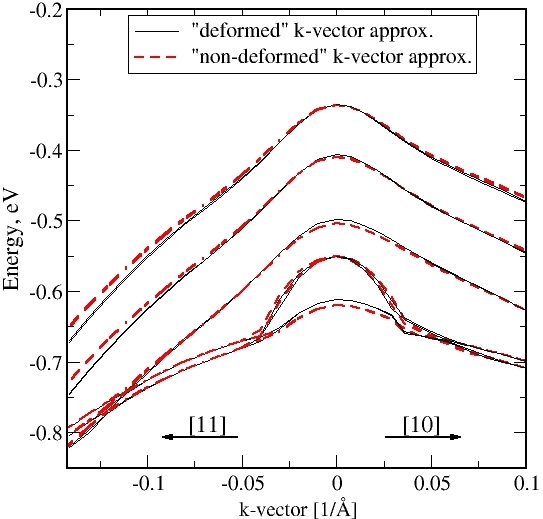
Example by Michael Povolotskyi, University of Rome "Tor Vergata"
(PhD Thesis):
The effect is small. And this is good, because if it were big that would
mean that the method cannot be applied.
(5 nm 211 InAs/GaAs quantum well, 8-band k.p calculation)
Broken gap type-II band alignment (for 8-band k.p calculations)
broken-gap = no ! (default)
=
yes !
=
full-band-density !
FB-EFA:
Either $quantum-model-electrons
or $quantum-model-holes
has to be specified.
=
full-band-density-electrons      !
$quantum-model-electrons has to
be specified.
=
full-band-density-holes          !
$quantum-model-holes
has to be specified.
           =
full-band-density-electrons-only !
FB-EFA:
The k.p Hamiltonian is solved only once. Both
$quantum-model-electrons and
$quantum-model-holes should be
specified.
           =
full-band-density-holes-only     !
$quantum-model-electrons and
$quantum-model-holes should be
specified.
FB-EFA = full-band envelope-function approach
The following error for 8-band k.p
Error update_kp: Cannot handle conduction band below valence band (E_cond_min
< E_val_max).
can be avoided when using broken-gap =
yes or broken-gap =
full-band-density.
This error appears when the lowest conduction band edge value is lower than the
highest valence band edge, i.e. a negative band gap is present.
In this case the code does not know how to distinguish between electron and hole
states in an 8-band k.p approach.
(Don't try to calculate the density when using broken-gap =
yes.)
The density can be calculated using broken-gap =
full-band-density.
This approach is termed FB-EFA (full-band envelope-function approach).
It is documented in detail in the following two papers:
- T. Andlauer, T. Zibold, P. Vogl
Proc. SPIE 7222, 722211 (2009)
- Full-band envelope function approach for type-II broken-gap
superlattices
T. Andlauer, P. Vogl
Physical Review B 80, 035304 (2009)
Piezo and pyroelectric charges at the boundaries
piezo-charge-at-boundaries =
no ! 1D/2D/3D (default)
=
yes ! 1D/2D/3D
pyro-charge-at-boundaries =
no ! 1D/2D/3D
=
yes ! 1D/2D/3D
If one assumes that one only simulates a small part of the device (as is the
case for most situations) one does not have an interface at the boundary (and
therefore no charge).
If one wants to have an explicit interface at the boundary (because the device
has a boundary there), one has to define a material-air interface in the input
file. Alternatively one can use this option.
The corresponding charges can be looked up in the output file
interface_densitiesD.txt ($output-densities).
This option might be useful for wurtzite (pyroelectric charges) and strained
zinc blende structures grown along other directions than [100] or [011] where
there is a nonzero piezoelectric polarization P at the boundary. In vacuum
P =
0. Therefore, there is div P nonequal to zero at the surface.
Set piezo and pyroelectric constants to zero
piezo-constants-zero =
no ! (default)
=
yes !
pyro-constants-zero =
no !
=
yes !
piezo-electric-constants,
pyro-polarization) from the database (database_nn3.in)
or input file to zero. This option is useful to study the effects of piezo and
pyroelectric charges in wurtzite independently. It is also useful for strained
structures in order to understand the influence of strain much better.
Piezoelectric electric constant: Second order
piezo-second-order
=
no ! (default)
= 2nd-order !
= 2nd-order-Tse-Pal !
identical to 2nd-order for
zincblende but different for wurtzite. B156 for zinc
blende is zero in Tse-Pal paper.
= 4th-order-Tse-Pal ! Tse-Pal model and Tse-Pal material parameters (4th order for
zinc blende but only 2nd order for wurtzite because in wurtzite 4th
order is not implemented.)
See e.g. - First- and second-order piezoelectricity in III-V
semiconductors
[BeyaWakata2011] A. Beya-Wakata, P.-Y. Prodhomme, G. Bester, Phys. Rev. B 84, 195207 (2011)
- [Bester2006] G. Bester et al., Phys. Rev. Lett. 96, 187602 (2006)
(zinc blende)
- [Patra2017] S. K. Patra, S. Schulz, Phys.
Rev. B 96,
155307 (2017) (wurtzite)
- [Pedesseau2012] L. Pedesseau et al., Appl. Phys. Lett.
100,
031903 (2012) (wurtzite)
Here, one can switch on the second order effect of piezoelectricity.
Obviously several piezoelectric parameters are needed.
- zinc blende: e14
(1st order effect); B114 B124 B156
(2nd order effect)
- wurtzite: e33 e31
e15 (1st order effect); B311 B312 B313 B333 B115 B125 B135 B344 (2nd order effect)
Note: In the simulated structure, a mixture of zinc blende and wurtzite
materials is allowed.
2nd-order
This is the model supported by the database_nn3.in
file, i.e. these parameters can be specified in the database or in the input
file.
- For zinc blende materials
the 2nd order model of [BeyaWakata2011] is used.
4 parameters are needed.
e14 B114 B124 B156
(default)
The equations for the second order terms read:
Px = 2 * B114 * eps_xx * eps_yz + 2 *
B124 * eps_yz * (eps_yy + eps_zz) + 4 * B156
* eps_xz * eps_xy
Px = 2 * B114 * eps_yy * eps_xz + 2 *
B124 * eps_xz * (eps_zz + eps_xx) + 4 * B156
* eps_yz * eps_xy
Pz = 2 * B114 * eps_zz * eps_xy + 2 *
B124 * eps_xy * (eps_xx + eps_yy) + 4 * B156
* eps_yz * eps_xz
- For wurtzite
materials, the 2nd order model of [Patra2017] is used.
11 parameters are needed.
e33 e31
e15 B311 B312 B313 B333 B115 B125 B135 B344
(default)
The equations for the second order terms
are given in eq. (3) in [Patra2017].2nd-order-Tse-Pal
- For
zinc blende materials it is identical to 2nd-order.
Additionally, it is
identical to 4th-order-Tse-Pal if one neglects 3rd and 4th order terms.
4 parameters are needed.
e14 B114 B124 B156
(default)
Note that the Tse-Pal model
assumes B114 = e114, B124 = e124
and B156 = e156 = 0.
- For wurtzite
materials, the 2nd order model of J. Pal, G. Tse et al., Phys.
Rev. B 84, 085211 (2011) is used.
6 parameters are needed.
See also H. Y. S. Al-Zahrani et al., Nano Energy 2,
1214 (2013).
e33 e31
e15 e311 e313 e333
The wurtzite material
parameters for this model can only be specified in the input file but not in
the database file database_nn3.in.
The implemented equations
are only valid for growth along the [0001] direction.
4th-order-Tse-Pal
The material parameters for this model can only be specified
in the input file but not in the database file database_nn3.in.
- For zinc blende materials
the model of G. Tse, J. Pal et al., J. Appl. Phys. 114, 073515 (2013)
is used.
It includes linear terms, 2nd,
3rd and 4th order terms for zinc blende.
13 parameters are needed.
e14 B114 B124 B156
e1114 e1124 e1224 e1234
e11114 e11124 e12224 e12234 e11234
Note that the Tse-Pal
model assumes B114 = e114, B124 = e124
and B156 = e156 = 0.
- For wurtzite
materials it is identical to 2nd-order-Tse-Pal.
Discontinous quantum charge density at material interfaces in 1D and 2D
For the single-band Schrödinger equation in 1D and 2D, we need a parallel
effective mass to calculate the quantum mechanical charge density. At material
interfaces, this parallel effective mass is not continous (because the materials
have different effective masses) which will lead to a discontinuity in the
quantum mechanical charge density.
By default, we use an averaged parallel effective mass value which is weighted
by the parallel effective masses at each grid point and the square of the
wave function psi² at each grid point (FUNCTION
get_mass_par_averaged). This will lead to a contious quantum
mechanical charge density.
However, especially in 2D this could lead to an enormous increase in CPU time,
especially if lots of eigenvalues are specified. Therefore the user can allow
for discontinous parallel effective masses (and thus a discontinous quantum
mechanical charge density) to speed up the calculations.
discontinous-charge-density-1band =
no ! 1D/2D (default)
=
yes ! 1D/2D
The figure on the left shows the quantum mechanical charge density of a 1D
quantum well for the case of discontinous-charge-density-1band =
yes.
The discontinuity in the parallel effective masses m(z) at material interfaces
leads to a discontinuity in the quantum charge density at interfaces.
The right figure shows (for a different quantum well!) a comparison of the two
approaches. The red line uses an averaged
parallel effective mo mass which leads to a continous quantum charge
density (discontinous-charge-density-1band =
no).
The x axis corresponds to the position in nm, the y axis to the charge density
in |e| * 1 * 1018 cm-3.
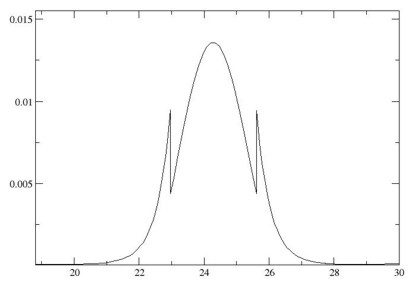 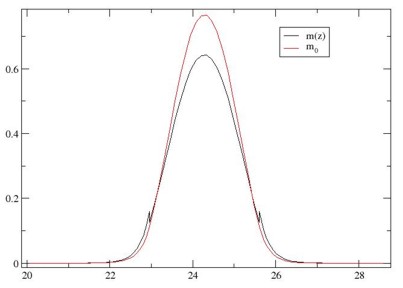
Superlattice
superlattice-option
= whole
! (default)
= 100-only
!
= 010-only
!
= 001-only
!
= 110-only
!
= 101-only
!
= 001-only
!
= 111-only
!
or along special directions in the superlattice Brillouin zone.
Note that the directions refer to the simulation coordinate
system and not to the crystal coordinate system.
Internally, only positive KSL values are
calculated.
superlattice-save-wavefunctions = yes
!
= no
!
no
Usually one is interested only in the eigenvalues and not so
much in the wave functions itself.
This option is necessary to avoid huge memory allocation,
e.g. especially in 3D for option whole.
Exchange-Correlation (XC)
exchange-correlation =
no ! (default)
=
LDA ! LDA = local density
approximation
=
LSDA ! LSDA = local spin density approximation
=
LDA-exchange !
local density approximation (only
exchange, for testing)
=
LSDA-exchange !
local spin density approximation (only exchange, for testing)
=
LDA-correlation !
local density approximation (only
correlation, for testing)
=
LSDA-correlation !
local spin density approximation (only correlation, for testing)
=
LDA-not-selfconsistent !
local density approximation (for testing)
- The exchange-correlation potential energies are written out but are not used
in the calculation.
=
LSDA-not-selfconsistent !
local spin density approximation (for testing) - The exchange-correlation
potential energies are written out but are not used in the calculation.
Calculates exchange and correlation potentials as a functional of the density
in LDA or LSDA.
Parameters for Ceperley-Alder model from J.P. Perdew and A. Zunger, Phys. Rev. B
23, 5048 (1981)
Depending on the type of polarization ([ unpolarized (LDA) , polarized (LSDA)
]), different sets of parameters have to be used.
[
unpolarized , polarized
]
gamma = [ -0.1423d0 , -0.0843d0 ]
beta1 = [ 1.0529d0 , 1.3981d0 ]
beta2 = [ 0.3334d0 , 0.2611d0 ]
A = [ 0.0311d0 , 0.0155d0 ]
B = [ -0.048d0 , -0.0269d0 ]
C = [ 0.0020d0 , 0.0007d0 ]
D = [ -0.0116d0 , -0.0048d0 ]
Exciton
coulomb-matrix-element
= yes
= no
To output Coulomb energy (= Hartree
energy) only (does not work yet).
calculate-exciton
= yes ! 1D/3D
= no ! 1D/3D
3D: To calculate exciton energy of electron and heavy hole state
self-consistently (Hartree approximation only).
It is also possible to calculate the
exciton energy of electron and light hole, or electron and split-off hole.
exciton-iterations
= 5 ! 3D for self-consistency loop (Hartree only)
exiton-iterations must be set too a much higher value (!).
There are two situations where exciton-iterations
is used for self-consistent Kohn-Sham eigenvalue problem:
- SUBROUTINE calc_exciton
(=> exciton-iterations = 50)
- SUBROUTINE calc_many_body_state_LSD (=> exciton-iterations =
150)
exciton-residual
= 1d-5 ! 3D for self-consistency loop
There are two further situations where exciton-residual
is used, namely for self-consistent Kohn-Sham eigenvalue problem:
- SUBROUTINE calc_exciton
(=> exciton-residual = 1d-5)
- SUBROUTINE calc_many_body_state_LSD (=> exciton-residual = 1d-6)
exciton-electron-state-number
= 1 ! electron ground state
= 2 ! 2nd electron
state
= 1 3 ! electron
ground state and 3rd state
exciton-hole-state-number
= 1 ! hole ground state
= 2 ! 2nd hole
state
= 2 3 ! 2nd and 3rd
hole state
= ...
For example with these integer numbers it is possible to specify:
- Calculate exciton energy of the electron ground state with
the hole ground state.
- Calculate exciton energy of the 2nd electron
state with the hole ground state.
- Calculate exciton energy of the electron ground state with
the 1st hole state, and then with the 2nd hole state.
- Calculate exciton energy of the 2nd electron
state with the 2nd hole state.
Note: The numbering of k.p states is twice as many as single-band because
spin up and spin down states are included.
Example: The 1st k.p hole state corresponds to the 1st
single-band holes state.
The 3rd
k.p hole state corresponds to the 2nd single-band holes state.
The 5rd k.p
hole state corresponds to the 3nd single-band holes state.
number-of-electron-states-for-exciton   = 3
! 2D

number-of-hole-states-for-exciton       =
3
! 2D
In 1D, these two specifiers are not used.
3D:
exciton: X0
-----------
number-of-electron-states-for-exciton = 1 ! electron ground state
biexciton: XX0
--------------
charged exciton: X-
-------------------
charged exciton: X+
-------------------
Note: The numbering of k.p states is twice as many as single-band because
spin up and spin down states are included.
Example: The 1st k.p hole state corresponds to the 1st
single-band holes state.
The 3rd
k.p hole state corresponds to the 2nd single-band holes state.
The 5rd k.p
hole state corresponds to the 3nd single-band holes state.
In 1D we currently have a routine that calculates the
exciton correction in type-I quantum wells (single-band only).
See tutorial "Exciton
energy in quantum wells":
The 1D output can be found here: Schroedinger_1band/exciton_energy1D.dat
It contains information on the exciton binding energy (in units of [meV]
and [Rydberg]) and on the exciton Bohr radius (which is the variational
parameter) in units of [nm].
To speed up the calculations, the user can provide an educated guess for the
start value of the variational parameter lambda.
Both of the following inputs are optional;
 exciton-lambda
= 2.0   ! [nm]
1D only (optional)
exciton-lambda-step-length = 0.05 ! [nm]
 ==> exciton-lambda
=  BohrRadius2DLimit

 ==> exciton-lambda-step-length = (BohrRadiusBulkExciton -
BohrRadius2DLimit) / (lambda_steps - 1)
In 3D we can calculate the exciton correction in quantum dots taking into
account the Coulomb potential (Hartree approximation).
This works for single-band Schrödinger equation for both electrons and holes,
as well as for 8-band k.p for both electrons and holes. One can
also treat the electrons within single-band and the holes within 6-band k.p.
The following output files are provided:
Schroedinger_1band/exciton_energy3D_cb001_vb001.dat (At present, also for
k.p calculations the output directory is the single-band directory.)
vb001 (= heavy hole)
vb002 (= light hole)
vb003 (= split-off hole)
E field [V/m], E_ex [eV],
E_el - E_hl, E_el0 - E_hl0, Delta_Ex, REAL(inter_matV(1))
...
0.000000E+000 0.788262E+000
0.778266E+000 0.797671E+000 0.940847E-002
0.992412E+000
E field [V/m]:
Electric field value (not fully implemented and tested yet)
E field = voltage-offset / lever-arm-length
For details, see
$output-1-band-schroedinger.
E_ex [eV]:
E_ex = E_el - E_hl - 0.5d0 * (mat_el - mat_hl) (Eq. (6.37), p. 79
in diploma thesis of Matthias Sabathil)
matrix element mat_el = < psi_hl | V_psi_el | psi_hl >
matrix element mat_hl = < psi_el | V_psi_hl | psi_el >
E_el - E_hl [eV]: Energy of the electron state minus
the hole state
E_el0 - E_hl0 [eV]:
Delta_Ex [eV]:
non-interacting electron and hole one-particle states (E_el0 -
E_hl0) and the energy of the exciton state E_ex.
Delta_Ex = E_el0 - E_hl0 - E_ex
REAL(inter_matV(1)):
| SUM(psi_el * psi_hl) |2
k.p: optical matrix element
Biexciton ground state
Schroedinger_1band/biexciton_energy3D_cb001_vb001.dat (At present, also for
k.p calculations the output directory is the single-band directory.)
vb001 (= heavy hole)
vb002 (= light hole)
vb003 (= split-off hole)
E field [V/m], E_biex [eV], E_el - E_hl, E_el0 - E_hl0, Delta_Ex, REAL(inter_matV(1))
...
0.000000E+000 0.254603E+001
0.128976E+001 0.135468E+001 0.163326E+000
0.000000E+000
E field [V/m]:
Electric field value (not fully implemented and tested yet)
E field = voltage-offset / lever-arm-length
For details, see
$output-1-band-schroedinger.
E_biex [eV]:
E_biex = 2 (E_el - E_hl) - 4 * 0.5d0 * (mat_el - mat_hl) - mat_elel -
mat_hlhl
(Eq. on p. 65
in PhD thesis of O. Stier, TU Berlin)
matrix element mat_el = < psi_hl | V_psi_el | psi_hl >
matrix element mat_hl = < psi_el | V_psi_hl | psi_el >
matrix element mat_elel = < psi_el | V_psi_el | psi_el >
matrix element mat_hlhl = - < psi_hl | V_psi_hl | psi_hl >
E_el - E_hl [eV]: Energy of the electron state minus
the hole state
E_el0 - E_hl0 [eV]:
Delta_Ex [eV]:
non-interacting electron and hole one-particle states 2*(E_el0 -
E_hl0) and the energy of the biexciton state E_biex.
Delta_Ex = 2*(E_el0 - E_hl0) - E_biex

REAL(inter_matV(1)):
| SUM(psi_el * psi_hl) |2
k.p: optical matrix element
Note: There might be problems with the current nextnano³ implementation
of the exciton routines for electrons at other valleys than Gamma (due to
degeneracies, splitting of bands) or for the light holes (single-band
approximation).
Tight-binding: Method and parameters
tight-binding-method = bulk-zincblende-sp3s*-nn
!     nn =
nearest-neighbor (20x20 matrix, including spin)
= bulk-zincblende-sp3-nn
!     nn =
nearest-neighbor
(16x16 matrix, including spin)
= bulk-graphene-Saito-nn
!     nn =
nearest-neighbor
= bulk-graphene-Scholz-nn      !
    nn =
= bulk-graphene-Scholz-3rd-nn  !
3rd-nn =
= bulk-graphene-Reich-3rd-nn   !
3rd-nn =
The units are [eV]. 16 parameters are required for zinc blende
materials, even in the case of bulk-zincblende-sp3-nn.
In this case, the s* related parameters must be zero.
tight-binding-parameters = -3.53284 !
Esa (GaAs)
0.27772 ! Epa
-8.11499 ! Esc
4.57341 ! Epc
12.33930 ! Es_a
4.31241 ! Es_c
-6.87653 ! Vss
1.33572 ! Vxx
5.07596 ! Vxy
0.0 ! Vs_s_
2.85929 ! Vsa_pc
11.09774 ! Vsc_pa
6.31619 ! Vs_a_pc
5.02335 ! Vs_c_pa
0.32703 ! Delta_so_a
0.12000 ! Delta_so_c
Note: Special case for graphene (3 parameters only, nearest-neighbor
tight-binding approximation):
tight-binding-parameters = 0.0
! [eV] E2p: site energy of the 2pz
atomic orbital (orbital energy)
-3.013 ! [eV] gamma0: C-C
transfer energy (nearest-neighbor, nn)
0.129 ! [] s0:
denotes the overlap of the electronic wave function on adjacent sites (nn)
Note: Special case for graphene (7 parameters only,
third-nearest-neighbor tight-binding approximation):
tight-binding-parameters = -0.28 !
[eV] E2p: site energy of the 2pz atomic orbital
(orbital energy)
-2.97 ! [eV] gamma0: C-C
transfer energy (nearest-neighbor, nn)
0.073 ! [] s0:
denotes the overlap of the electronic wave function on adjacent sites (nn)
-0.073 ! [eV] gamma1: (2nd-nn)
0.018 ! [] s1:
(2nd-nn)
-0.33 ! [eV] gamma2: (3rd-nn)
0.026 ! [] s2:
(3rd-nn)
Special option for third-nearest-neighbor tight-binding approximation in
graphene:
tight-binding-calculate-parameter = no
! (default) use 7
parameters (E2p,gamma0,gamma1,gamma2,s0,s1,s2)
= E2p !
= gamma1 !
E2p or gamma1 can be calculated internally in order to
force E(K) = 0 eV where K is the K point in the Brillouin zone. In that case,
only 6 parameters are used (although 7 parameters have to be present in the
input file). The parameter to be calculated is simply ignored inside the code.
Graphene potential fluctuation
graphene-potential-fluctuation = 0.0
0.0001
4.0
! [eV] [eV] [] (default)
= 0.0
0.0001
!
[eV] [eV]
= 0.0
! [eV] (default, i.e. "ideal" graphene layer)
= 0.100
!
[eV]
= 0.100
0.001
3.0
! [eV] [eV] []
= PotentialFluctuation EnergyGridResolution
sigma_factor ! [eV] [eV] []
For Dirac point potential fluctuation see H. Xu et al,. APL 98, 133122
(2011).
We assume a Gaussian distribution of the potential fluctuation.
The 1st value of these array entries corresponds to the fluctuation
in potential energy of the Dirac point in units of [eV]. Useful
values lie in the range from 0 eV to 0.200 eV.
The 2nd value of these array entries (optional) corresponds to the
energy grid resolution of the Gaussian integration in units of [eV].
The 3rd value of these array entries (optional) is related to the
integration range of the Gaussian integration in units of [].
The integration range is from [ - sigma_factor
* PotentialFluctuation
, + sigma_factor *
PotentialFluctuation ] [eV].
Adjusting the 2nd and 3rd value has implications on CPU
time.
3.0
is a very reasonable value for
sigma_factor
and also an energy grid resolution of 1 meV (0.001)
is sufficient.
CBR method
get-k-vector-dispersion-for-lead-modes =
arccos ! (default)
= use_ln !
= acosIN !
DACOS (only for testing)
In principle, all methods for arcos(x) = cos-1(x) should be
identical. (acosIN only for certain
energy range where k is real.)
At present, it seems that use_ln
works for electrons only.
(for holes: 'mass' is negative)
It seems that arccos works for both,
electrons and holes. (for holes: 'mass' is negative)
k = 1 / dx * cos-1 ( ( E - El,m ) / 2 t - 1 )
For more details, see Matthias Sabathil's documentation of CBR_example,
page 4 ("Lead modes").
|