nextnano3 - Tutorial
next generation 3D nano device simulator
1D Tutorial
Band gap of strained AlGaInP on GaAs substrate
-> AlGaInP_on_GaAs_1D_as_in_tutorial_nn3.in

-> AlGaInP_on_GaAs_1D_as_in_tutorial_no_bowing_nn3.in

-> AlGaInP_on_GaAs_1D_nn3.in / *_nnp.in  -
input file for the nextnano3 and nextnano++ software
-> AlGaInP_on_GaAs_1D.xls
These input files are included in the latest version.
Band gap of strained AlGaInP on GaAs substrate
In this tutorial we want to study the band gaps of strained AlxGayIn1-x-yP on a GaAs
substrate.
The material parameters are taken from
Band parameters for III-V
compound semiconductors and their alloys
I. Vurgaftman, J.R. Meyer,
L.R. Ram-Mohan
J. Appl. Phys. 89 (11), 5815 (2001)
To understand the effect of strain on the band gap on the individual
components of this quaternary, we first examine the effects on
1) AlP
strained tensilely with
respect to GaAs
2) GaP
strained tensilely with
respect to GaAs
3) InP
strained compressively with respect to GaAs
4) AlxGa1-xP strained
tensilely with respect to
GaAs
5) GaxIn1-xP strained
with respect to GaAs
6) AlxIn1-xP
strained
with respect to GaAs
7) Al0.4Ga0.6P strained tensilely
with respect to GaAs
8) Ga0.4In0.6P strained compressively
with respect to GaAs
9) Al0.4In0.6P strained
compressively with respect to GaAs
Each material layer has a length of 10 nm in the simulation.
The material layers 4), 5) and 6) vary its alloy contents linearly:
4) AlxGa1-xP from 10 nm to
20 nm from x=0.0 to x=1.0
5) GaxIn1-xP from 30
nm to 40 nm from x=0.0 to x=1.0
6) AlxIn1-xP
from 50 nm to 60 nm from x=1.0 to x=0.0
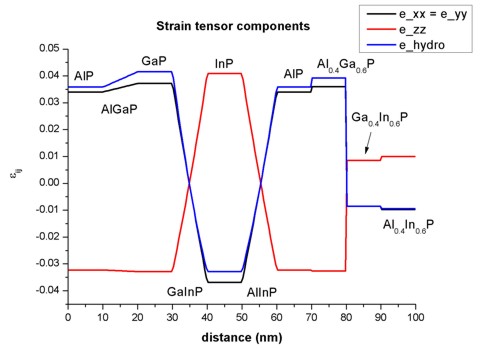
Strain
-> AlGaInP_on_GaAs_1D_as_in_tutorial_nn3.in
There is no external stress applied to the structure, so Poisson's ratio
holds.
All layers are strained pseudomorphically with respect to a GaAs substrate (i.e.
the layers are biaxially strained in the plane perpendicular to the growth
direction to match the lattice constant of GaAs).
The biaxial strain in the layers can be
calculated with this formula:
exx = eyy = (asubstrate - a) / a
where a is the lattice constant.
The output of the strain tensor can be found in this file:
=> strain1/strain_cr1D.dat
The hydrostatic strain is the trace of the strain tensor and corresponds to
the volume deformation:
ehydro = Tr(eij) = exx + eyy + ezz
Band gaps
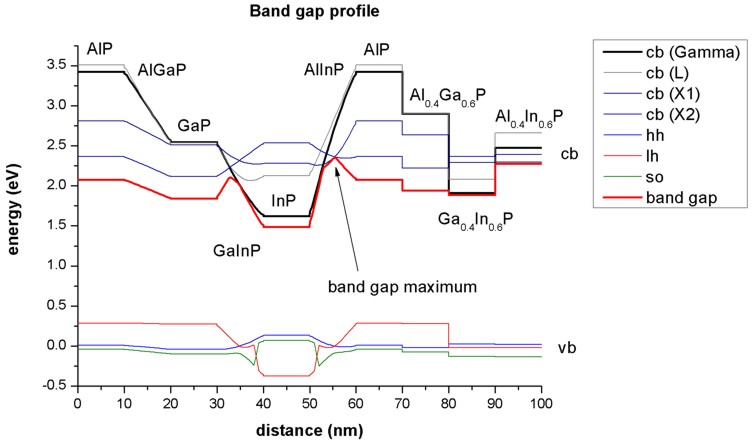
The following figure shows the conduction band edges at the Gamma, L and X
points and the heavy hole, light hole and split-off hole valence bands.
The red line shows that band gap, i.e. the
difference between the lowest conduction band minimum and the valence band
maximum.
The band gap maximum occurs at Al0.55In0.45P (2.355 eV).
The conduction and valence band edges have been obtained taking into account
the shifts and splittings of the bands due to strain and deformation potentials.
Note that conduction and valence band offsets are not taken into account in
this plot.
The zero of energy was taken to be the unstrained heavy hole / light hole band
edge.
Due to strain, the degeneracy of the heavy and light hole is lifted. Also,
the X band splits into two X bands (2 fold and 4 fold degeneracy).
In the case of tensile (compressive) strain, the light (heavy) hole band is
the valence band maximum.
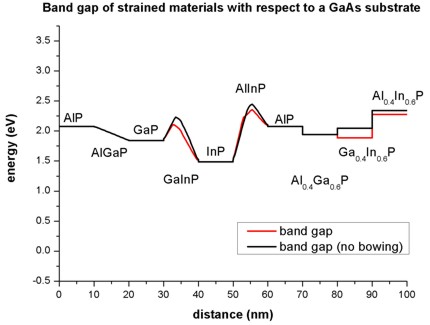
Note that the material parameters include band gap bowing.
-> AlGaInP_on_GaAs_1D_as_in_tutorial_nn3_no_bowing.in
The following figure compares the overall band gap to the case where band gap
bowing has been neglected.
- The nextnano3 software does not include quaternaries.
However, there is the option to simulate lattice-matched quaternaries.
They only have one variable x (and not two, x and y, as for a general quaternary) and are thus represented as "ternaries" with only one variable x.
!---------------------------------------------------------------------------!

	! AlGaInP lattice matched to GaAs --- Source: Vurgaftman et al., J. Appl. Phys. 89 (11), 5815 (2001)

      ! (Al(x)Ga(1-x))0.51In0.49P
      ! (Al0.52In0.48P)(x)(Ga0.51In0.49P)(1-x)

	!---------------------------------------------------------------------------!

 material-name   = (Al(x)Ga(1-x))0.51In0.49P
- The nextnano++ software supports quaternaries.
 quaternary_constant{

    name = "Al(x)Ga(y)In(1-x-y)P"

    alloy_x = 0.255

    alloy_y = 0.255

 }
So if you are interested in quaternaries, this software should be preferred.
- The input files
*_as_in_tutorial_*.in match the results from the
above documented tutorial.
Note that in the tutorial, conduction and valence band offsets are not taken into account.
The zero of energy was taken to be the unstrained heavy hole / light hole band edge
for all materials.
The nextnano++ input file (*_nnp.in) includes a quaternary material (between 100 nm and 110 nm).
The corresponding nextnano3 input file (*_nn3.in) includes a lattice matched quaternary material (between 100 nm and 110 nm).
Note that in these input files, conduction and valence band offsets are taken into account - in contrast to the
figures in the tutorial.
- Appendix E of the
PhD thesis of T. Zibold is related to the nextnano++ implementation of quaternaries.
|