[ Home ] [ News ] [ Contact ] [ Search ] 1D Tandem solar cell

 About us
 Useful Links
 Publications
 Copyright notice
 nextnano³ documentation

 -> Download Software
 * password protected


Up
 

nextnano3 - Tutorial

next generation 3D nano device simulator

1D Tutorial

Cascade solar cell (tandem solar cell)

Note: This tutorial's copyright is owned by Stefan Birner, www.nextnano.de.

Author: Stefan Birner
Please send comments to nextnano3 (-at-) wsi.tum.de.

If you want to obtain the input files that are used within this tutorial, please contact stefan.birner@nextnano.de.
-> 1DCascadeSolarCell.in


Cascade solar cell (tandem solar cell)

-> 1DCascadeSolarCell.in

Here, we solve the Poisson equation in an AlGaAs/InGaAs monolithic cascade solar cell (tandem solar cell).

The layout is based on US patent 4,179,70: Cascade solar cell

See also the following publication for more details:

Computer Modeling of a Two-Junction, Monolithic Cascade Solar Cell
M.F. Lamorte, D.H. Abbott
IEEE Transactions on Electron Devices 27 (1), 231 (1980)


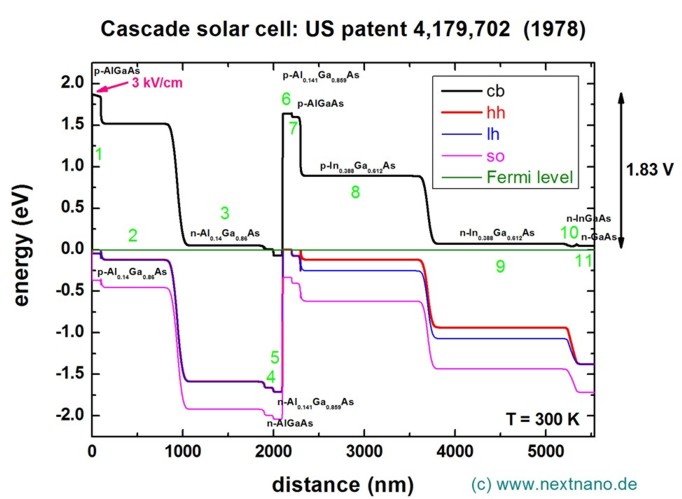
The following figure shows the conduction band edge and the valence band edges (heavy hole, light hole and split-off hole) of this solar cell at zero bias.
The built-in potential has been calculated to be 1.83 V.
At the left side (region 1), a graded p-type AlGaAs layer has been used to generate an electric field of 3 kV / cm (= 30 meV / 100 nm).
We assumed that all materials are strained with respect to the GaAs substrate, thus the degeneracy of heavy and light hole valence band edges is lifted, especially inside the InGaAs regions.


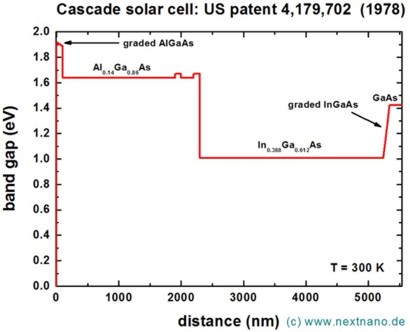
The band gap as a function of distance is shown in the following figure.


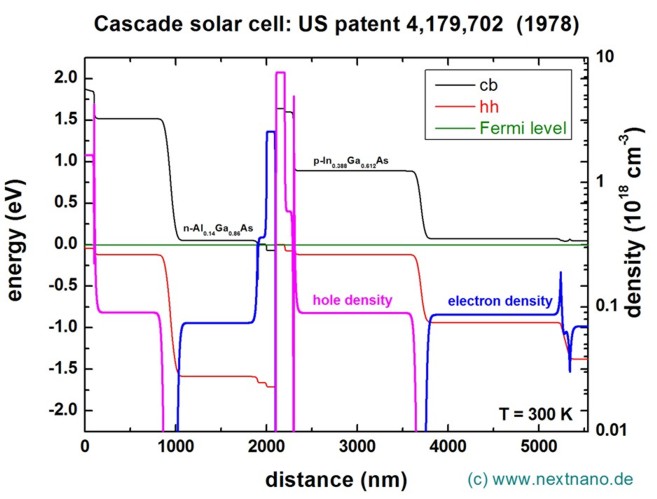
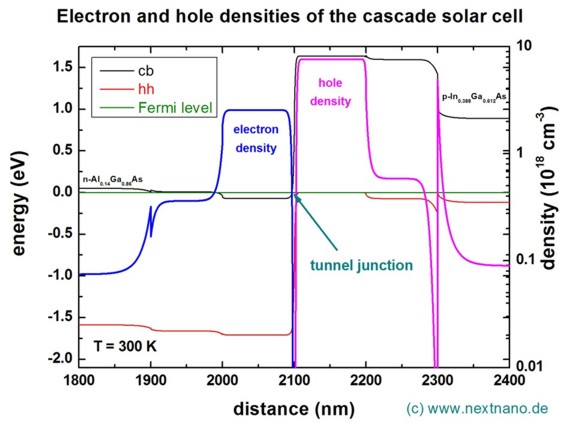
Here, the electron and hole densities are plotted.


Tunnel junction

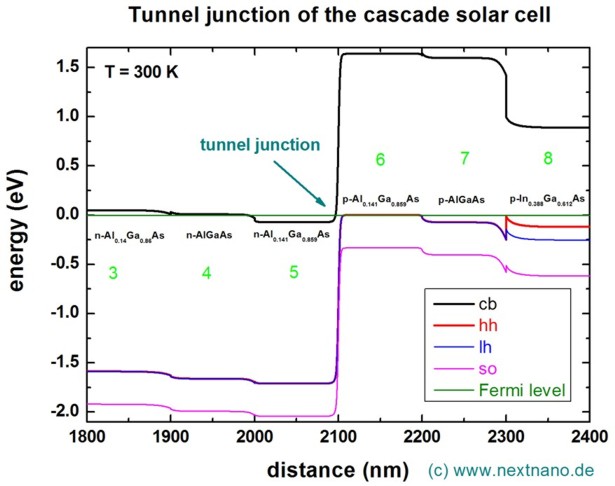
The area around the tunnel junction which is in the middle of the device at ~2100 nm is shown in this plot:


The electron and hole densities in the vicinity of the tunnel junction are shown in this graph.
Note that the density has been calculated classically (without solving the Schrödinger equation, i.e. without quantum mechanics).


  • Please help us to improve our tutorial. Send comments to nextnano3 (-at-) wsi.tum.de.
   
Last modified: 09-Jun-2009   -   optimised for Microsoft Internet Explorer 7®