|
| |
nextnano3 - Tutorial
2D Tutorial
Landau levels of a bulk GaAs sample in a magnetic field
Author:
Stefan Birner
If you want to obtain the input files that are used within this tutorial, please
check if you can find them in the installation directory.
If you cannot find them, please submit a
Support Ticket.
-> 2DBulkGaAs_LandauLevels_nn3.in / *_nnp.in - input file for the nextnano3 and nextnano++
software
Landau levels of a bulk GaAs sample in a magnetic field
In this tutorial we study the electron energy levels of a bulk GaAs sample
that is subject to a magnetic field.
- The GaAs sample extends in the x and y directions (i.e. this is a
two-dimensional simulation) and has the size of 300 nm x 300 nm.
At the domain boundaries we employ Dirichlet boundary conditions to the
Schrödinger equation, i.e. infinite barriers.
- The magnetic field is oriented along the z direction, i.e. it it
perpendicular to the simulation plane which is oriented in the (x,y) plane).
We calculate the eigenstates for different magnetic field strengths (1 T, 2 T,
3 T), i.e. we make use of the magnetic field sweep.
  $magnetic-field


   magnetic-field-on
  = yes

   magnetic-field-strength
  = 0.0     !
0 Tesla = 0 Vs/m2
   magnetic-field-direction
  = 0 0 1   !
   magnetic-field-sweep-active
  = yes     !

   magnetic-field-sweep-step-size
  = 1.0     !
   magnetic-field-sweep-number-of-steps = 3
  !
   output-magnetic-vector-potential     = yes
	!
$end_magnetic-field
- A useful quantitiy is the magnetic length (or Landau magnetic length)
which is defined as:
lB = [hbar / (me* wc)]1/2
= [hbar / (|e| B)]1/2
It is independent of the mass of the particle and depends only on the magnetic
field strength:
- 1 T: 25.6556 nm
- 2 T: 18.1413 nm
- 3 T: 14.8123 nm
- The electron effective mass in GaAs is me* = 0.067 m0.
Another useful quantity is the cyclotron frequency:
wc = |e| B / me*
Thus for the electrons in GaAs, it holds for the different magnetic field
strengths:
- 1 T: hbarwc = 1.7279 meV
- 2 T: hbarwc = 3.4558 meV
- 3 T: hbarwc = 5.1836 meV
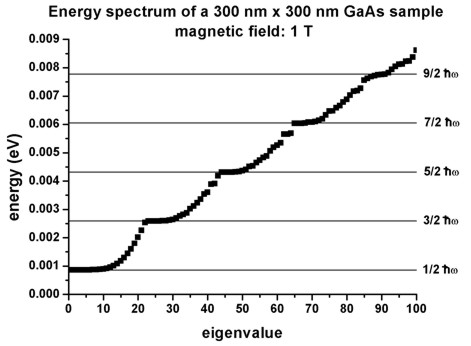
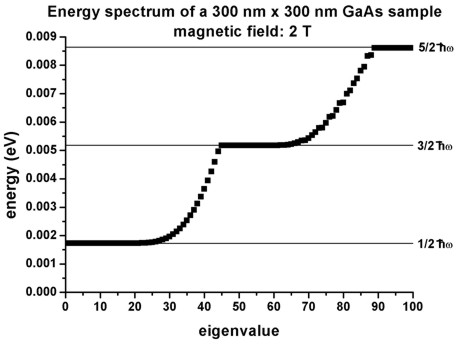
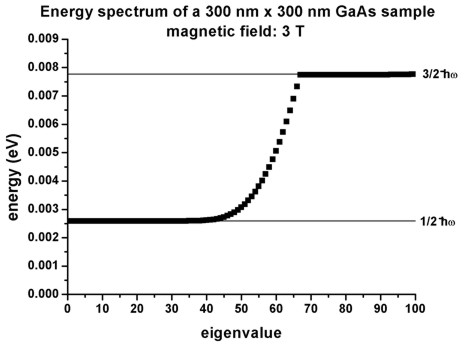
- The energy spectra for different magnetic fields (1 T, 2 T, 3 T) look as
follows:
- The Landau levels are given by En = (n - 1/2) hbarwc
where n = 1,2,3,...
- The number of states for each Landau level can be calculated as follows
(see P.Y. Yu, M. Cardona, Fundamentals of Semiconductors, p. 536, 3rd
ed.):
N = LxLy |e| B / h = 1/(2pi) LxLy / lB2
(ignoring spin)
where Lx and Ly are the lengths in the x and y
directions (300 nm in this example) and lB is the magnetic length.
N(1 T) = 21.76 ==> ~22 states per Landau level (in the
figure above: 22 as it should be)
N(2 T) = 43.52 ==> ~44 states per Landau level (in the
figure above: 44 as it should be)
N(3 T) = 65.29 ==> ~66 states per Landau level (in the
figure above: 66 as it should be)
Note that N is independent of n.
- For the calculations, we used the symmetric gauge A =
-
1/2 r x B = 1/2 B x r
leading to the following energies (see J.H. Davies, The Physics of
Low-Dimensional Semiconductors, p. 222):
En,l = (n + 1/2 l + 1/2 |l| - 1/2) hbarwc
One can see that all states having a negative value of 'l' are degenerate with
the states with l=0, i.e. the allowed energies are independent of l if l < 0
(for the same n).
The energies increase if l increases (for l > 0 and for the same n).
- The motion in the z direction is not influenced by the magnetic field and
is thus that of a free particle with energies and wave functions given by:
Ez = hbar2 kz2
/ (2 m*)
psi(z) = exp (+- i kz z)
For that reason, we did not include the z direction into our simulation
domain, and thus only simulate in the (x,y) plane (two-dimensional
simulation).
|